









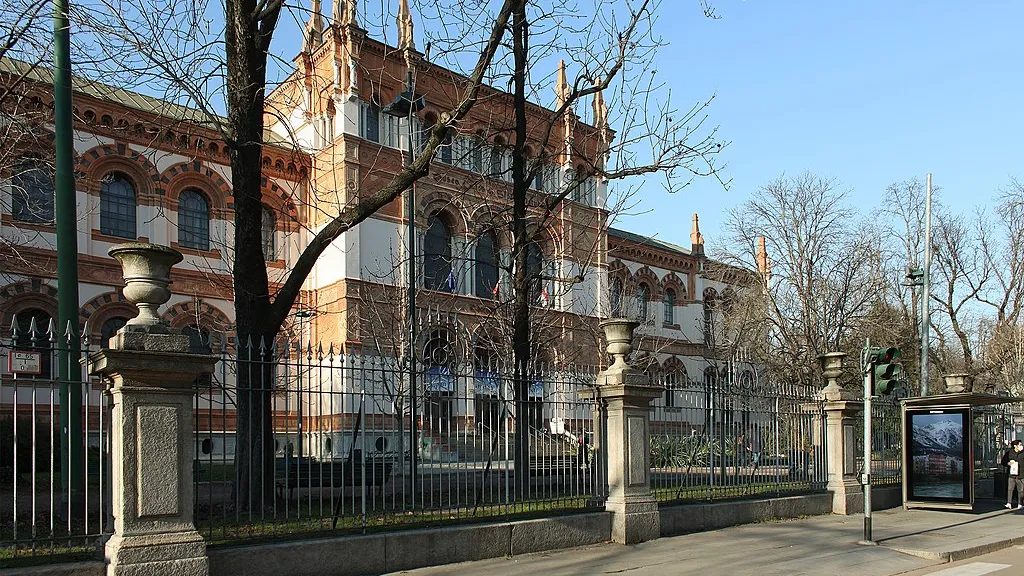
The Natural History Museum in Milan is the oldest public museum in the city.
It first opened its doors in 1844, having changed its location several times since then due to the constantly growing collection.
At the moment, the museum is the most significant in Italy and one of the most important in Europe.
A large role in its activities is also devoted to scientific research.
The section dedicated to the animal world undoubtedly attracts the most interest from visitors.
Numerous dioramas reproduce in minute detail the most diverse corners of our planet, with the life of their inhabitants seemingly frozen before our eyes.
Hanging from the ceiling of one of the halls is a giant whale skeleton (19.3m), and a slightly smaller sperm whale skeleton (12m), which can also be seen in the museum’s halls.
The mineralogy section displays the most interesting minerals from the 30,000 collected in the museum’s collection: the largest crystal of sulfur in the world, a Brazilian topaz weighing 40 kg, and much more.
In the paleontology section, among other things, it will be interesting to see the skeletons of dwarf elephants that lived in Sicily. A whole hall is dedicated to dinosaurs.
Here, to the delight of children, the most vivid representatives of this extinct family are reproduced as if alive. Among them is the terrifying predatory Tyrannosaurus Rex!
The exhibition is complemented by halls dedicated to entomology (the science of insects), human evolution, and its interaction with the environment.
The museum has a bookstore where you can purchase various souvenirs, as well as a bar-cafeteria.
The Natural History Museum is located in the City Garden. Here you will also find a playground, attractions, a summer café, and a planetarium, making this corner of Milan recommended for family visits.