







The tour includes the “Colors of Bologna” tour and adds a visit to:
The Church of St. Stephen and the Basilica of St. Dominic.
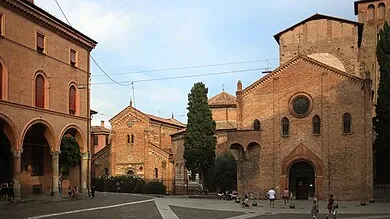
“The Seven Churches” of Santo Stefano are not a single structure, but a whole Christian complex. According to legend, Saint Petronius, the bishop of Bologna in the 5th century, decided to build a complex of buildings in place of the Temple of Isis, modeled after the Church of the Holy Sepulchre in Jerusalem. The Santo Stefano complex includes the 8th-century Church of St. John the Baptist, the 5th-century Church of the Holy Sepulchre, the 13th-century Church of the Holy Trinity, which is connected to the other buildings by a portico, the 4th-century Church of Saints Vitalis and Agricola, and the Chapel of the Bend, dedicated to the strip of cloth that wrapped the head of the Virgin Mary in mourning.
The Church of St. John the Baptist is built in the Romanesque style with a single nave and a presbytery above the crypt. The presbytery was rebuilt in the 17th century. Inside, you can see a 14th-century sculptural crucifix, and the walls are decorated with 15th-century frescoes. In the five-nave crypt, you can see various columns. According to tradition, the height of one of them exactly equals the height of Jesus Christ (170 cm). At the base of this column, the relics of saints were kept, whose images were recently discovered under the plaster on the nearby wall. Another small 15th-century fresco can be seen in the left nave; it is called “Madonna della Neve.”
The oldest in Santo Stefano, the Church of the Holy Sepulchre is an octagonal structure with 12 columns supporting the vault from the inside. The church has a source of clean water, which is symbolically associated with the holy water of the Jordan River.
The Basilica of San Domenico is one of the main churches in Bologna. Here, inside the exquisite tomb created by Nicola Pisano and Arnolfo di Cambio, the relics of Saint Dominic, the founder of the Dominican order, are kept. By the way, the young Michelangelo also contributed to the creation of the saint’s tomb. It was here that Saint Dominic died in August 1221 and was buried. His remains were placed in a simple marble sarcophagus in 1233, and later a luxurious tomb was built depicting events from the saint’s life. Thus, the Basilica of San Domenico was born, which later became a model for many Dominican churches around the world. Today, within the walls of the church, you can see the works of great masters of the past – Giunta and Nicola Pisano, Niccolò dell’Arca, Jacopo da Bologna, Guido Reni, Filippo Lippi, and Guercino.
The square in front of the basilica is paved with cobblestones, as it was in the Middle Ages. In the center stands a brick column with a statue of Saint Dominic, and behind it rises a marble column with the “Madonna with Rosary,” installed here to mark the end of the plague epidemic in the city. Behind the first column, you can also see the graves of Rolando de Passaggeri and Egidio Foscarari, adorned with an arch of Byzantine marble with a relief from the 9th century.
Here you can see an ancient organ, on which the young Wolfgang Amadeus Mozart played at the end of the 18th century. Also, a luxurious choral piece made in the 16th century in the Renaissance style. Its unique wood inlays are considered the “eighth wonder of the world.”