






Verona is one of the most beautiful and interesting cities in Italy. In addition to the story of Romeo and Juliet, its rich ancient heritage, stunning castle, and numerous beautiful civil architecture, Verona has many churches. These churches are very ancient, richly and elegantly decorated with a magnificent history.
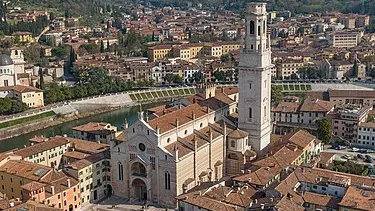
The cathedral – along with the baptistery, the Chapter library, and the Church of Saint Helena – forms a unified architectural ensemble. Churches have been built on this site since the 4th century, but they were destroyed by fires and earthquakes. Only the 12th-century cathedral has partially survived – from it, the entrance with twisted columns, winged griffins, and a relief depicting the Virgin Mary remains. Later, it was completed in the Gothic style – high narrow windows, rose windows, and pointed arches appeared. The upper part of the facade was constructed later in the 17th century, so stylistically it differs from the rest of the building. Just like the top of the bell tower, which was added in the last century. The white marble facade of the cathedral is a unique combination of Gothic and Romanesque styles, and inside, ancient mosaic floors, medieval carvings, and stucco have been preserved. The temple has three naves, separated by columns of red marble; in the two side naves, organs are symmetrically installed. The left one is decorated with a 16th-century painting depicting the Assumption of the Virgin Mary. In the central nave – the altar and frescoes. In the chapels – paintings from the Renaissance era, mostly by local masters. Of particular value are the Romanesque frescoes of the 12th century and the sarcophagus of the 14th century with the relics of Saint Agatha located in one of the chapels.
The Church of San Zeno Maggiore – the patron saint of Verona, whose relics are kept in the crypt. The church is one of the best examples of Romanesque style in Italy, with the interior walls painted with frescoes from the 12th to 14th centuries, bronze doors with scenes from the New and Old Testaments dating back to the 11th-12th centuries, and the famous triptych from the beginning of the Renaissance “The Glory of the Virgin Mary” attributed to Andrea Mantegna, an elegant monastery courtyard typical of that era. Here, Castellani filmed a movie about Romeo and Juliet.
The Church of Santa Anastasia – the largest in Verona, a beautiful example of Gothic style. The church is considered a gallery of paintings by Veronese masters, with the Pellegrini chapel housing a masterpiece by the artist Pisanello: the famous fresco about the legend of Saint George and the Princess, and in the Rosary chapel, “Madonna of Humility” by Lorenzo Veneziano from the 14th century. An active organ from the first half of the 17th century.
The double church of San Fermo Maggiore – Saints Fermo and Rustico: the lower church from the 11th century in Romanesque style with frescoes from the 12th to 14th centuries, and the upper church from the 14th century in Gothic style with a wooden ceiling resembling the keel of a ship from that era and a fresco by the famous Gothic period artist Pisanello “The Annunciation”.
The Church of Santa Maria in Organo, famous for its wooden inlays from the Renaissance by the master Fra Giovanni da Verona. Giorgio Vasari, the author of the famous “Lives of the Artists”, considered this sacristy the most beautiful in Italy.
Churches of Verona