






Grimani Palace:
Opened its doors for visits after almost 30 years of restoration – a masterpiece of Renaissance architecture.
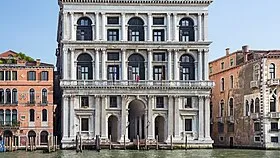
Grimani Palace is a palace in Venice on the Rio di San Luca canal, at the point where it flows into the Grand Canal. It was built during the Renaissance, and its current appearance dates back to 1556-1575. The palace consists of three parts and a small backyard. The facade of the palace is decorated with multicolored marble. The highlight of the interior is the ‘Hall of Psyche’, adorned with frescoes by Francesco Menzocchi, Camillo Mantovano, and Francesco Salviati. Taddeo Zuccaro and Giovanni da Udine also contributed to the palace’s decoration.
Originally built for Doge Antonio Grimani. After his death, from 1532 to 1569, it was successively rebuilt by the doge’s heirs, first Vittore Grimani, the city’s chief prosecutor, and then Giovanni Grimani, a cardinal and patriarch of Aquileia.
Presumably, the contract was executed by Michele Sanmicheli.
The palace was finally completed in 1575 by Giovanni Rusconi. The door portal was designed by Alessandro Vittoria.
The Grimani family of the Santa Maria Formosa branch boasts worthy representatives – Doge Antonio, elected to this honorary position at a very advanced age, and his grandson Giovanni Grimani, patriarch of Aquileia – a great connoisseur of antiquities.
This palace does not fit the standard of Venetian mansions either in its structure or its decorative design. But you can expect an abundance of pleasant surprises and revelations: starting with the courtyard decorated in the Roman style, the grand staircase of the palace crafted by decorator Federico Zuccari – who skillfully painted the living rooms of the villa’s owner, Cardinal d’Este, at the Villa d’Este in Tivoli, near Rome.
Harmony and brilliance accompany the visitor from hall to hall, and in the hall of the nymph Callisto, one can philosophize on the topic of mythology and the cosmos.
Do not miss the Bosch hall under any circumstances. Do not be surprised, this is not a typo; Grimani’s passion for Northern art enriched the family collection with four works by Bosch.
Open every day except Monday, December 24, January 1, and May 1.