







Doge’s Palace, also known as Palazzo Ducale:
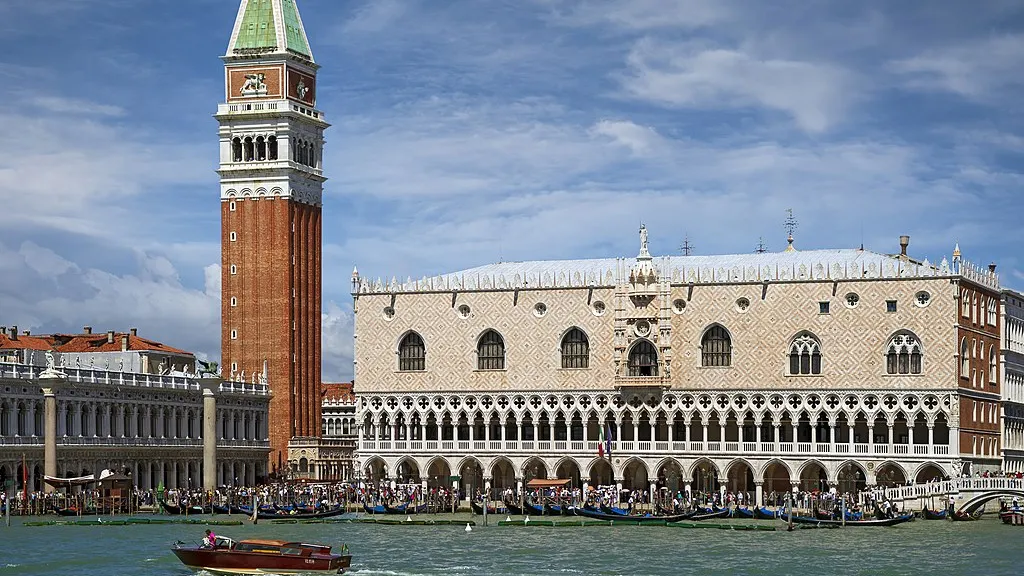
This is the main attraction of Venice, an architectural monument of Italy, executed in the Gothic style. The project was designed by Filippo Calendario.
The construction of the palace took place over 115 years from 1309 to 1424. In 1577, a fire occurred that significantly damaged the building. The palace was restored in the old style despite the fact that the Renaissance architecture was flourishing.
The building was the residence of the doges. The doge was the head of the Venetian Republic, elected for life through a multi-stage voting process. Candidates for the position of doge came from the most influential families of Venice. The institution of doges lasted for over a thousand years, abolished by Napoleon in 1797.
Despite its name, the Doge’s Palace served not only as the residence of the rulers of the Republic of Saint Mark. The personal apartments of the head of Venice occupied only the northern wing of the building. The palace also hosted meetings of the members of the Great Council and the Senate. Here, hearings of the Supreme Court took place, and the secret police and the Inquisition operated. On the first floor were legal offices, a chancellery, a maritime office, and other municipal institutions.
Thus, the Doge’s Palace was the home of the government of Venice, an amazing city-state that did not know absolute power for several centuries of its vibrant history.
The palace is a three-story building in the shape of the letter “P”, made of gray, white, and pink marble. The building has two facades that form a right angle. The first floor features a gallery of pointed arches that rest on columns. The second floor is also formed by columns, but they are thinner and taller, and at the top, there is a row of loggias decorated with a four-leaf clover ornament. The third floor is a smooth wall clad in white marble, pierced by large and small windows.
On the southern facade, there is a balcony that served as the doge’s tribune. Above the balcony is the monument of Justice by Alessandro Vittoria. The wall around the perimeter is crowned with ornate white marble battlements.
The palace has two main entrances: Porta della Carta, the paper gates; the main entrance of the Doge’s Palace. Above the gates is depicted the winged lion of Saint Mark and before it on his knees is doge Francesco Foscari. The paper gates were named due to the tradition of posting announcements on them. Porta del Frumento, the wheat gates, lead to the embankment and are the starting point for tours of the palace.
The true “pearl” of Venice, the majestic Doge’s Palace is rightly considered the most popular attraction not only in Italy but throughout Europe. The luxurious interiors of the palace were created by the best masters of the Renaissance and represent a vivid testimony to the rich cultural and political life of the Venetian Republic.
Open every day except December 24 and January 1.