








Padua is one of the most famous historical and cultural centers in northeastern Italy. According to legend, Padua, the ancient name ‘Patavium’, was founded by the mythical hero of Troy, Antenor, celebrated in Virgil’s poem ‘Aeneid’. One of the jewels of the city is the Scrovegni Chapel. The chapel was commissioned by Enrico Scrovegni for the salvation of his father Reginaldo, who was accused of usury, and where you can admire the frescoes of the famous Florentine artist Giotto (1302-1306 fresco painting). The Scrovegni Chapel is listed as a UNESCO World Heritage Site.
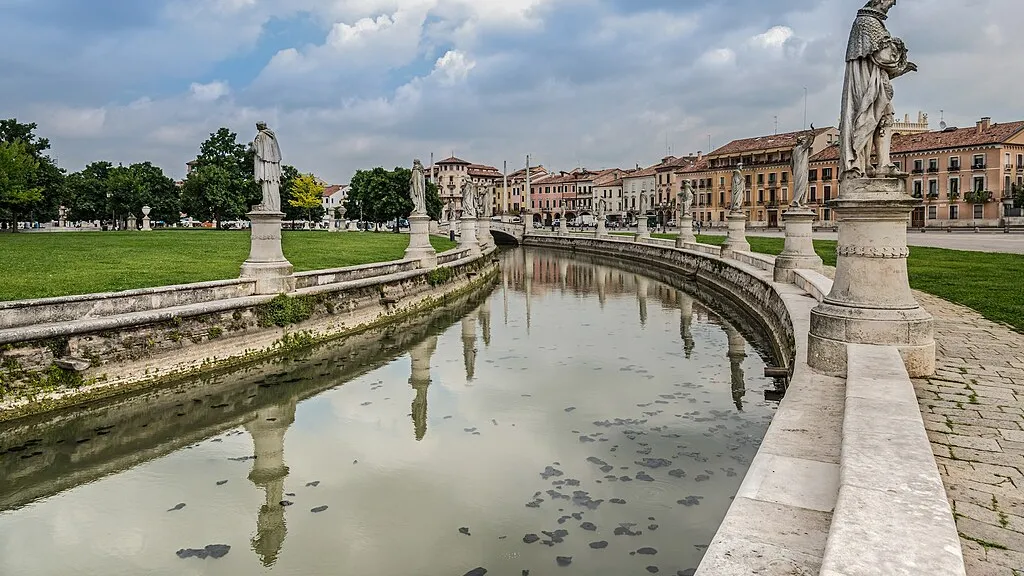
The Basilica of St. Anthony is the center of religious and cultural pilgrimage. Construction began in 1232, a year after the death and canonization of the saint. Inside this temple, you can admire frescoes and sculptures by famous masters of the past, among whom are: Giotto, Donatello, Giusto di Menabuoi, Altichiero, Tullio Lombardi, Andrea Mantegna, Giovanni Maria Falconetto, and many others. Nearby the basilica is one of the largest and most beautiful squares in Europe, ‘Prato della Valle’ (88620m²) with 78 statues around the central part of the square. In the Roman era, there was a theater ‘Zairo’ for gladiatorial fights, later the stones of the theater were used in the construction of the canal around the island ‘Memmo’ – the central part of the square.
The facade of the Basilica of St. Martyr Justina faces this square, who suffered a martyr’s death in 304. In terms of size, it ranks 11th in the Christian world. Inside the basilica rest the relics of many saints, including: St. Martyr Justina, the first two bishops of Padua – Maximus and Prosdocimus, and part of the relics of St. Apostle Matthew. In the left wing of the basilica rest the honorable relics of St. Apostle and Evangelist Luke. It is believed that they arrived here during the iconoclastic heresy in the 8th century. According to other sources, the relics of St. Apostle Luke were brought from Constantinople during the reign of Emperor Julian the Apostate (361-363).
The ancient University (founded in 1222 and after the University of Bologna is one of the oldest in Europe) also deserves special attention. It was here that the famous astronomer Galileo Galilei taught for 15 years, and in 1594 the first ‘Anatomical Theater’ in Europe was opened at this university, made entirely of wood in the shape of a funnel, where anatomy classes continued until the end of 1872.
Two other majestic buildings in the city are ‘Caffè Pedrocchi’ (1826-1831) and ‘Palazzo di Giustizia’ (1218 – 19), the latter surrounded by medieval squares: Fruit Square, Grass Square, and Lord’s Square.
The duration of the tour is 3 hours with a guide, by car, and considering the road.
Attention: with a visit to the Scrovegni Chapel, the tour may take 4 hours including travel.