






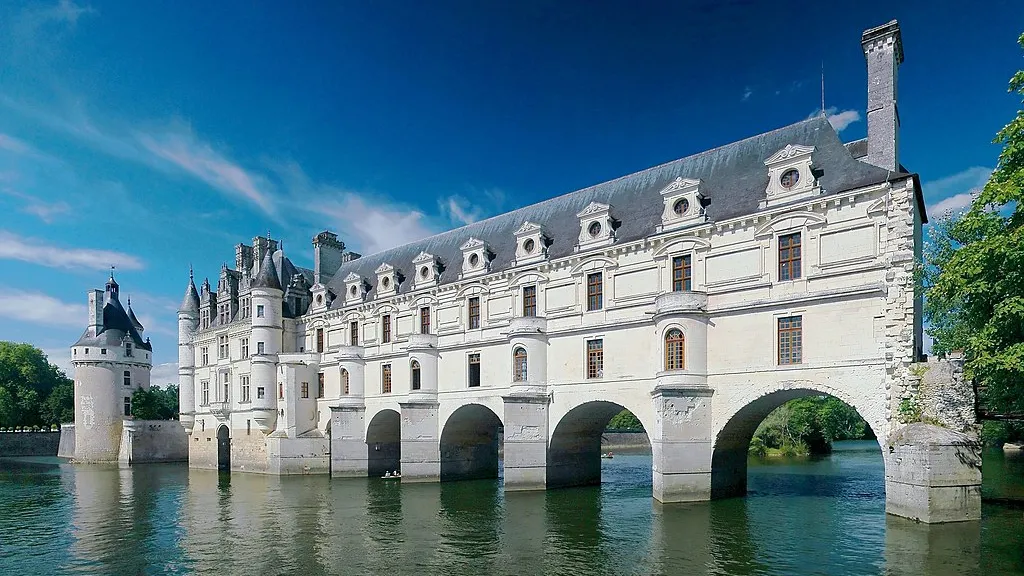
Chenonceau. A bridge castle spanning a tributary of the Loire – the Cher River. Probably the most beautiful of all the Loire castles. The right to own it was contested by Henry II’s mistress, Diane de Poitiers, and his wife, Catherine de’ Medici. The castle has seen dozens of kings and queens, the famous feasts of Catherine de’ Medici and her sensual court. From here, Mary Stuart left for her homeland.
From here, France was governed. Later, Rousseau worked here as a governor and wrote his books, and Voltaire and other celebrities visited. The castle is preserved as if its crowned owners still lived in it. To the left of the castle is a garden created by Diane de Poitiers, and to the right – by Catherine de’ Medici. This is private property.
Amboise. The history of this place begins in the 1st century AD, and from the 10th century, castles have succeeded one another. The preserved castle dates back to the 15th-16th centuries. From the top, from the height of the powerful cliff on which the castle stands, a breathtaking view of the Loire and the picturesque old streets opens up. In the lower part of the castle are wine cellars where you can taste wine and cheese. The castle features a 15th-century church, 14th-century towers and fortifications, a 15th-century council chamber, and royal apartments. Here lived Louis XI, Charles VIII, Louis XII, Francis I, Catherine de’ Medici, whose name is associated with the history of the famous Amboise conspiracy of the Huguenots, and others. Today, the castle belongs to the Count of Paris’s foundation – the heir to the crown. This castle is linked to the beginning of the Renaissance in France. Here is also the grave of Leonardo da Vinci.
Clos Lucé. A small medieval castle located next to the royal one and connected to it by an underground passage. Here, Leonardo da Vinci spent the last three years of his life and died. You can visit the rooms where Leonardo lived and learn about 40 of his inventions in various fields: military engineering, urban planning, hydraulics. During a guided walk through the castle park, you can see 16 huge machines invented by Leonardo, 32 transparent canvases with sketches and fragments of his paintings.
Cheverny. The first palace in the classical style, which served as a model for many mansions and palaces, such as Pavlovsk. The delightful symmetry of the building, the beauty and elegance of the facade. The magnificent furniture from the time of Louis XIII has been preserved, along with paintings by the best Italian and French masters, tapestries from the early 17th century that take your breath away, a collection of weapons, the personal chest of Henry of Navarre, and much more. Perhaps the best interiors among all the Loire castles. This is private property, and part of the rooms is closed to visitors – a marquis resides there. An English park surrounds the castle. Here you can visit the kennel and the hall of hunting trophies. See a dovecote from the 14th century and a row of trees that are several hundred years old.
Chambord. A masterpiece of the Renaissance, this castle was built in the 16th century. French kings visited here up to Louis XIV. Molière created his plays here. A magnificent castle that has seen many monarchs in its time and stands as a symbol of royal power, is located in a huge park surrounded by the longest wall in France. Clearly, this is the largest and most fantastic of all the castles, and many stories are associated with it…
Fougères-sur-Bièvre – a well-preserved castle from the 15th century.
Montresor – impressive remnants of a royal citadel from the 13th – 15th centuries and a town from the 15th century.
Chissay – a castle from the 12th-15th centuries. All three castles are on the way.
The Loire River Valley is the heart of France. Everything here is interesting for tourists – its villages, towns, landscapes, houses (often from the 15th century), parks, gardens, everyday life…