






In the 1st century BC, there was a small Roman settlement here – Divio (wonderful, divine – thanks to the purity of the local river). In the Middle Ages, it became a powerful, well-fortified city. In the 11th century, it became the capital of Burgundy. Throughout the 14th and 15th centuries, the Dukes of Burgundy claimed absolute power in the French kingdom. The founder of the Burgundian branch of Valois is considered to be Philip the Bold (1364-1404). Although he was still a child during the Battle of Poitiers, this did not prevent him from bravely fighting alongside his father John II the Good. For his bravery, he was granted the possession of Burgundy.
The court of the Dukes of Burgundy is considered one of the most brilliant in Europe. It was during this time that Dijon became one of the richest and brightest European capitals. And it’s no wonder: the dukes owned a significant part of Europe. Famous sculptors and painters (for example, the great master of the old Flemish school Jan van Eyck) were in their service…
But eventually, the French kings subdued Burgundy, for which they fought with the emperors for several centuries…
Today, the city’s European political significance is behind… Now it is known worldwide more for its gastronomic recipes. For example, the famous French aperitif owes its name to one of the mayors of Dijon – Kir, and the mustard we know is called Dijon mustard. Here were born recipes for dishes with truffles (which are harvested in Burgundy, and in the fall, at fairs, you can eat an omelet sprinkled with truffles, costing… a few euros). And who hasn’t tried snails prepared in the Burgundian style?
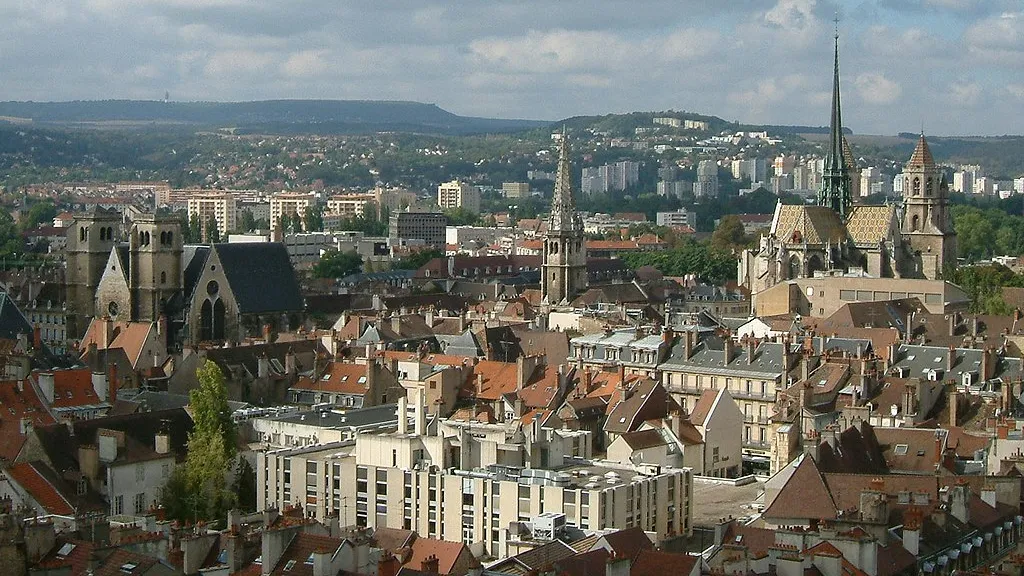
Dijon is a fairly large city. It combines the features of refined French provinciality, the Middle Ages, royal architecture of the flourishing period of the French monarchy, and modernity. Here you will find the ducal palace, semicircular squares with streets fanning out, medieval and Renaissance houses and palaces, Gothic cathedrals, and mansions from the 16th, 17th, and 18th centuries. The streets near the Notre-Dame Cathedral are very interesting. The magnificent Gothic temple was founded between 1230 and 1250 during the reign of St. Louis and consecrated in 1334. Here stands the oldest statue of the “Black Madonna” in France, presumably dating back to the 11th century. According to legend, it saved the city from the Swiss on September 11, 1513. As the residents of Dijon claim, it was the statue of the Virgin Mary that also helped rid the city of the fascists in 1944.
In the Cathedral of Saint-Bénigne, there is one of the most beautiful crypts in France. Believers descend into it to pray at the graves of Christian martyrs…
And, of course, a special charm of Dijon is the abundance of colorful tiled roofs, for which Burgundy is famous.
Numerous museums, cathedrals, and the sheer size of the city – all this offers a whole day to spend in it. But even a 2-3 hour walk will make you fall in love with Dijon. If you wish to have lunch or dinner there, a whole range of good restaurants awaits you, including several with Michelin star ratings.