







Le Marais – a district where kings lived in the 14th-16th centuries. It begins behind the city hall, where (in the previous building) the story with the queen’s ball pendants described by Dumas took place, and ends at the Place de la Bastille,
where a column with the Genius of Freedom rises and the modern Opera building stands out. The outlines of the former fortress are laid out with cobblestones, and you will be surprised when you see their sizes…
On the same street, there are residential houses from the late 14th-15th centuries, castles, and mansions from the same era, as well as palaces from the 17th-18th centuries, and “Ottoman” buildings from the 19th century.
Le Marais (Le Marais) means “swamp” in French: there used to be an ancient channel of the Seine here. Then the river flowed differently, but continued to flood the banks during times of flooding. Even in Roman times, a road leading from the City Hall to the Bastille ran along this street.
In 1358, King Charles V, frightened by a popular uprising, fled here from the castle on the island of the City. He settled near the Church of Saint-Paul (Eglise Saint-Paul-Saint-Louis) and built an entire palace complex. One mansion belongs to the king, another to the queen, a third to the royal children, nearby are the palaces of nobles, a park, cages with lions and other wild animals. The entire complex is protected by the hastily built fortress of the Bastille.
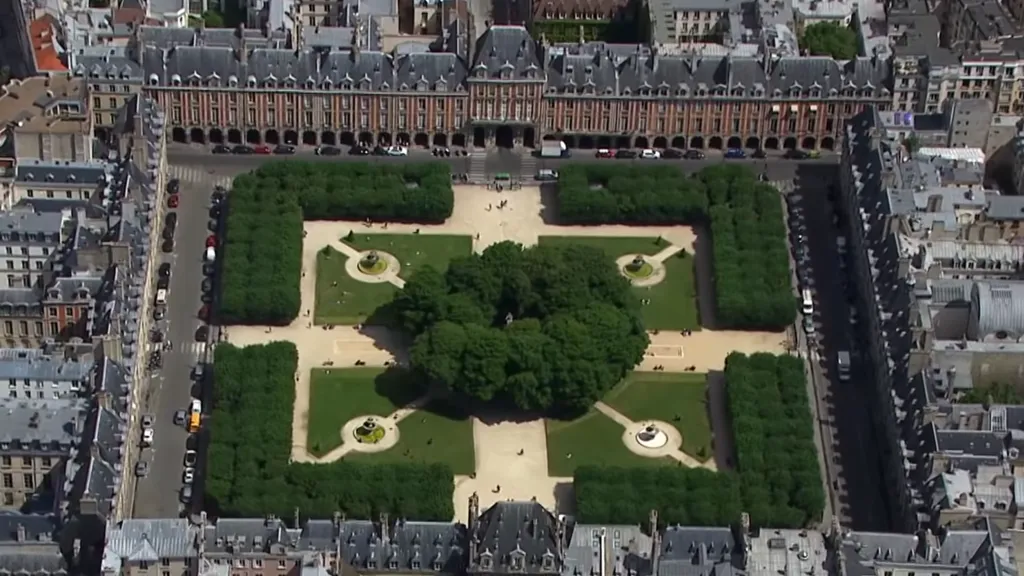
However, the king’s palace faces the Seine, where sewage is dumped and it smells bad. Therefore, Charles V builds another palace, La Tournelle (La Tournelle). It is in La Tournelle that kings will be born, live, and die. Up until the tournament during which, in the mid-15th century, Henry II, husband of Catherine de’ Medici, will die from a splinter of a spear that accidentally hits him in the eye. Catherine de’ Medici will order La Tournelle to be demolished and will begin to build the Tuileries (fr. Tuileries), while Henry IV will build the second royal square of Paris on the site of La Tournelle, which is now called Place des Vosges (fr. Place des Vosges).
Place des Vosges, except for the square in the center, has been preserved as it was in 1606. Here you can stroll through the courtyards of the palace of the first minister Henry IV, sit in famous restaurants, and marvel at the urban planning genius of Henry IV.
Le Marais is the most fashionable district of Paris in the 17th century, and Place des Vosges is its center. That is why Dumas settled Milady here, where the nephew of Richelieu, Madame Delorme, Madame de Savigny lived, and in the 19th century – Victor Hugo and Théophile Gautier…
Not far from the square is the richest church of the 17th century – Saint-Paul and Saint-Louis. The first stone of its foundation was laid by Louis XIII, the first mass here was served by Richelieu, in silver vessels here were kept the hearts of Louis XIII and Louis XIV, which one of the revolutionary artists used as a basis for mixing paints…
Behind the church, in the building of the modern Lycée Charlemagne, the Jesuits once studied. Nearby is part of the city wall and towers from the 12th century, picturesque courtyards with antique shops, mansions.
On the banks of the Seine stands, perhaps, the most beautiful castle in Paris (15th century) – the Hôtel de Sens (fr. Sens). In the 16th century, it was the headquarters of Cardinal de Guises, and here, already in the early 17th century, settled the 53-year-old Queen Margot.
Rue des Francs Bourgeois is the most fashionable street in Paris in the 17th century. It resembles a thread on which precious stones – mansions – are strung… In the courtyard of one of them is the only surviving sculpture of Louis XIV, cast during his lifetime, in the courtyard of another – a French park, in the third – a dazzling ceremonial courtyard…
In the palaces of the 17th-18th centuries, there are libraries, associations, museums. In Le Marais lived Beaumarchais, Balzac, Dode. On Tuesdays, Flaubert, Zola, Turgenev came to visit the latter…
Today, Le Marais is a district where you will see unique scenes: same-sex families live here, there is an ancient Jewish quarter, original fashion boutiques, jewelry shops, bars, and restaurants, some of which will not let you in… Here, everything is a little different than in the rest of Paris…