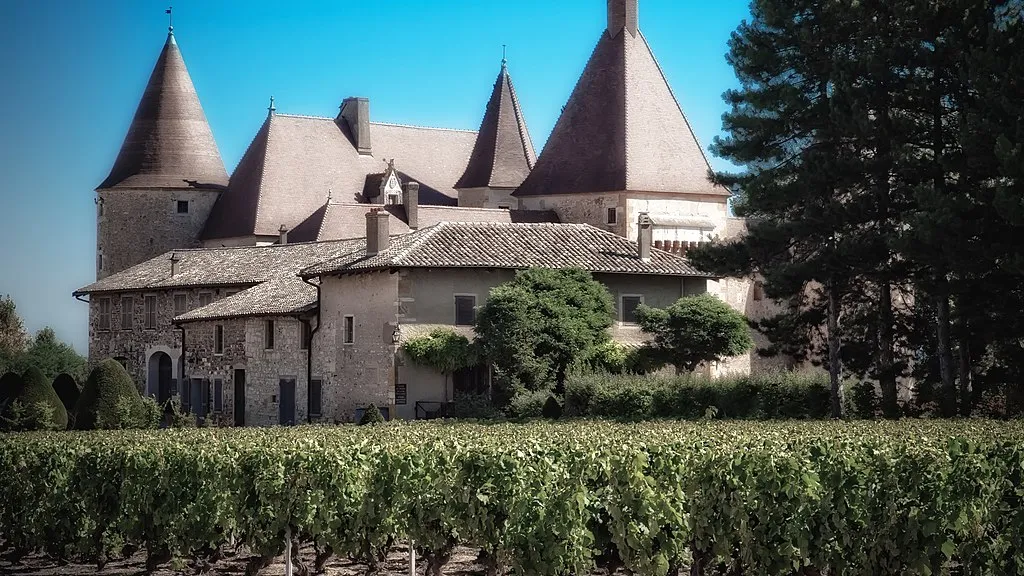







The first mention of winemaking between Lyon and Mâcon dates back to the mid-10th century, and in 1395 the cultivation of the grape variety “black Gamay with white juice” (Camay Noir a jus Blаnс) was officially permitted only in the Beaujolais region and simultaneously banned throughout the rest of Burgundy. Currently, two-thirds of all global plantings of the Gamay variety are in Beaujolais. It is commonly believed that Beaujolais wines are a hymn to young wine, which is consumed just two months after the harvest, ceremoniously uncorking bottles exactly at midnight on the third Thursday of November. Beaujolais got its name from the ancient capital of the town of Beaujeu, which translates to “beautiful game” – a region where smoked meats, sausages, cervelats, and various meat products are particularly loved, from which many simple and intricate dishes are prepared. Beaujolais wines combined with traditional cuisine create a celebration among friends. This is a democratic wine that allows for culinary fantasies. The tradition of celebrating Beaujolais Nouveau emerged in the 19th century. The grape harvest began earlier than in other places, and the fermentation of the wine took place during its transportation by barges along the Saône River or by carts to the suburbs of Lyon. It is precisely because of the short maturation period of Beaujolais that it retains its lightness and aroma, which varies from year to year, depending on the harvest and weather conditions. In the old days, during the holiday, wine flowed like a river – it was poured into special bottles called “pot.” Until 1846, these were 1-liter bottles, known as “Lyon bottle” (Pot Lyonnais) or “City bottle” (Pot de ville), and when its volume was reduced to the current traditional 46 cl (centilitre), it almost led to a revolution among local neighborhood drinkers, who felt overlooked and deceived. The 46 cl bottles were displayed on the bar counter, and customers paid for a meter (!), measuring the length of the row of empty “pots.” In a meter, there were 12 bottles, and the thirteenth was usually offered for free “on the house.” It was then that the expression “boyau rouge” emerged, meaning “to be a good drinker.” Even by our Russian standards, the load on the liver is serious. This tradition ceased to exist only during World War II when the Germans introduced special taxes and rules for the sale of branded wines in France during the occupation. After the war, the French government introduced special rules for the sale of AOC wines. Initially, young wines were allowed to be sold from November 13, and then, after several decades, in 1985, the date for the sale of young Beaujolais was set – from the third Thursday of November. Preparations for it begin six days in advance. Posters are hung with the famous words “Le Beaujolais Nouveau est arrivé!” (The new Beaujolais has arrived!). For many decades, this has been one of the favorite folk holidays in France. Competitions for the “best pitcher,” “golden bottle” are organized in restaurants and bistros, and there are even guides to Beaujolais bistros published worldwide. And if you are planning to go to France in November – here is a list of the best Beaujolais bistros in Paris. Travels through the Beaujolais region often begin at the small village of Vauxrenard in its northern part. It is located on a hill and is famous for its unique view of almost half of all crus du Beaujolais (wine-growing areas of Beaujolais). There is a special walking route of about three kilometers, from where both the typical landscape of the region and the vineyards familiar from guidebooks are clearly visible. A wine museum is a must-see on the list of local attractions. Its exhibition opened a decade ago in the old railway station of the town of Romaneche-Thorins. The House of Beaujolais (Maison des Beaujolais) in the village of Saint-Jean d’Ardieres right by highway No. 6 has been in existence for half a century and operates without days off. The Museum of Viticulture and Winemaking (Musee de la Vigne et du Vin) with a wine tasting cellar is located in Vaux en Beaujolais deep in the region. There is also a rich exhibition “Sources of Beaujolais” (Sources du Beaujolais) in the ancient Beaujeu. There is much to see in these places for lovers of historical heritage. Numerous ancient castles illustrate the history and culture of France over the centuries. Some of these castles accept guests – you can spend several days getting to know the local wines and cuisine. You can also stay in small cozy guesthouses in wine estates. One of the remarkable castles in the region is the Chateau de Bagnols, located on the slopes of green hills in the heart of the Beaujolais province, a true masterpiece of 13th-century architecture. For those who love unexpected attractions, there are also non-specialized establishments like the Museum of Sewing Machines in the village of Amplepluis. Here once lived the inventor of these useful machines, and their evolution is vividly demonstrated in the museum’s exhibition with about a hundred samples from 1830 to the present day. The town of Tarare, slightly to the south, becomes the center of a grand muslin festival every five years (in years ending in 0 or 5), which was celebrated for an entire week in 2000. The compact area (about thirty villages) southwest of Villefranche is called Pierres Dorees – literally “golden stones.” It is notable for the typical buildings of this area made of unusually warm-colored stone – depending on the weather and lighting, ochre or light terracotta; this stone was used to build residential houses and fences, churches, and castles. About a hundred years ago, local quarries not only supplied the surrounding areas with convenient and beautiful building materials but also sent it to Lyon and even to nearby Switzerland. Villages, castles, and towns are made of golden, eye-pleasing stone and scattered across picturesque hills covered with the most beautiful vineyards in France… Wine and gastronomic tourism enthusiasts usually enjoy the diverse programs of the Beaujolais Wine School (I’Ecole Beaujolaise des Vins) in the city of Villefranche-sur-Saone, founded in 1140 and considered the capital of this wine region. Here you can organize a special tasting for advanced gourmets or a program for beginners of varying lengths – half a day, a whole day, or a weekend, even for a week if you have the strength: with trips to vineyards and cellars, with overnight stays in winemakers’ estates. All programs are available both individually and in groups, in Russian, French, and other European languages. Comprehensive seminars on the wines of the region are conducted with consideration of local gastronomy, meaning that participants will not only be introduced to the technology of viticulture and winemaking and taught the basics of tasting but will also be advised on optimal food and wine pairings.
Wines and castles