







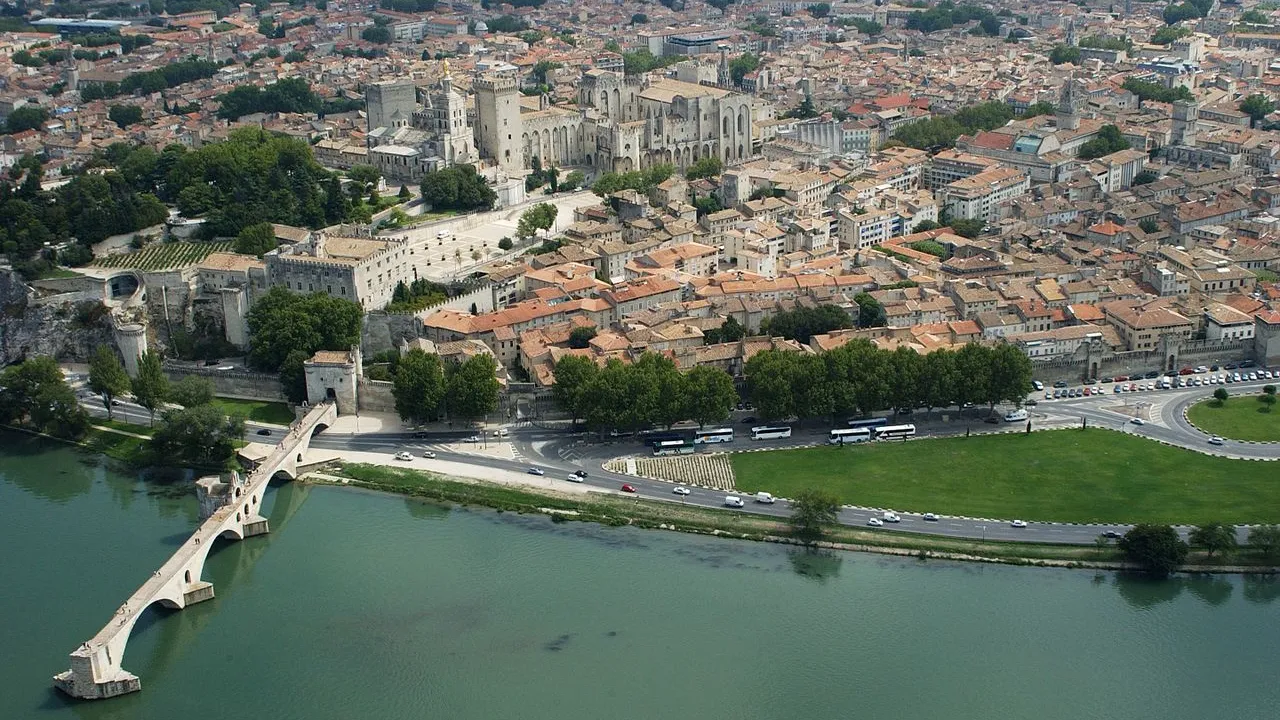
This is one of the most interesting cities in France – the city of popes and theaters, churches and bells, historical monuments and museums.
In ancient times, Avignon was the capital of the Gallic tribe of the Cavari and was called Aéunyon (“Lord of the waters”). The Phoenicians built a river port here, later improved by the Romans. Until the beginning of the 14th century, there were no significant events in the city’s history, but in 1309, at the insistence of French King Philip IV, Pope Clement V moved his residence from Rome to Avignon. Thus began the “Avignon Papacy,” which lasted about 70 years. From 1309 to 1377, seven popes succeeded each other on the holy throne located in Avignon. In 1348, the city was officially purchased by Pope Clement VI from Queen Joanna of Naples (as contemporaries believed, this sale for a pittance redeemed the queen’s sin of husband-murder). Under papal rule, the city became a refuge for all exiles, smugglers, counterfeiters, and outcasts. Petrarch called Avignon of that time the “second Babylonian confusion” and the “city of sin.” The city remained under papal control until 1791. Having been the capital of the Catholic world for a long time, the city was actively built up with churches, monuments, and mansions. There were previously 20 male and 15 female monasteries in Avignon. Rabelais dubbed it the “ringing city” (la ville sonnante) due to the constant ringing of bells. During the revolution, some churches were destroyed or repurposed for other uses. However, many medieval structures have been preserved. The main legacy left by the papal court is the largest Gothic Papal Palace of the 14th century in Europe, covering more than 15 thousand square meters. The palace was built over 30 years and consists of two parts: the Old Palace (1334-42) and the New Palace (1342-52). Externally, it resembles a real fortress: high, thick walls with narrow windows, powerful arches, and wide loopholes give the castle a traditionally harsh and impregnable look typical of medieval buildings. Inside is the Hall of Consistory, whose walls are adorned with tapestries and portraits, the Chapel of St. John with almost intact wall paintings, the Chapel of St. Martial with frescoes by Giovannetti, the Room of the Deer, painted with scenes from secular life, the Pope’s chambers, and other equally interesting rooms. The city is also known for another architectural monument of the Middle Ages – the famous St. Bénezet Bridge (Pont St Bénezet) of the 12th century, which, like the Papal Palace, is listed by UNESCO as a World Heritage Site. Its construction lasted eight years. The bridge spanned two arms of the Rhône over 900 m. In 1226, it was almost completely destroyed, with only four spans and the chapel of St. Nicholas remaining. Another adornment of the city is the Gothic Cathedral of Notre-Dame-des-Doms, which houses a bishop’s throne made of white marble, frescoes, paintings, and the tombs of Popes Benedict XII and John XXII. This cathedral contains one of the most famous organs in the world – the “golden organ.” Avignon is famous for its museums.
The Palais du Roure houses the Museum of Jewelry and the Museum of Provençal and Italian Art. Here you can see illustrations for Dante’s “Divine Comedy,” engravings by Piranesi, as well as a collection of figurines of saints, letters from Obanel and his friends, the famous Mistral stagecoach, and a unique collection of bells. The Musée Louis Vouland showcases decorative arts of the 17th and 18th centuries. The Musée Petit-Palais – the former residence of bishops and archbishops – has a collection of Italian artists from the 13th to the 16th centuries. It houses the famous Botticelli Madonna and Child. The exhibition at the Musée Jean Vilar is dedicated to theater and stage art. The Calvet Museum exhibits a large collection of archaeological finds and paintings from the 16th to the 20th centuries. The best time to visit Avignon is during the International Theater Festival, which takes place annually in July. July Avignon represents a large theater fair, where numerous theater troupes, musicians, dancers, and spectators from all over the world gather. In the picturesque square of the city – Place de l’Horloge – a huge crowd fills the terraces of cafes and restaurants, where one can relax and recharge for the upcoming night while waiting for the performance.