






Saint-Rémy-de-Provence. This is one of the brightest representatives of typical Provençal towns. Boulevards drowning in the shadows of plane trees, squares adorned with fountains, cozy streets of the old town, as well as the atmosphere that reigns in this city, with its markets and a large number of traditional festivals.
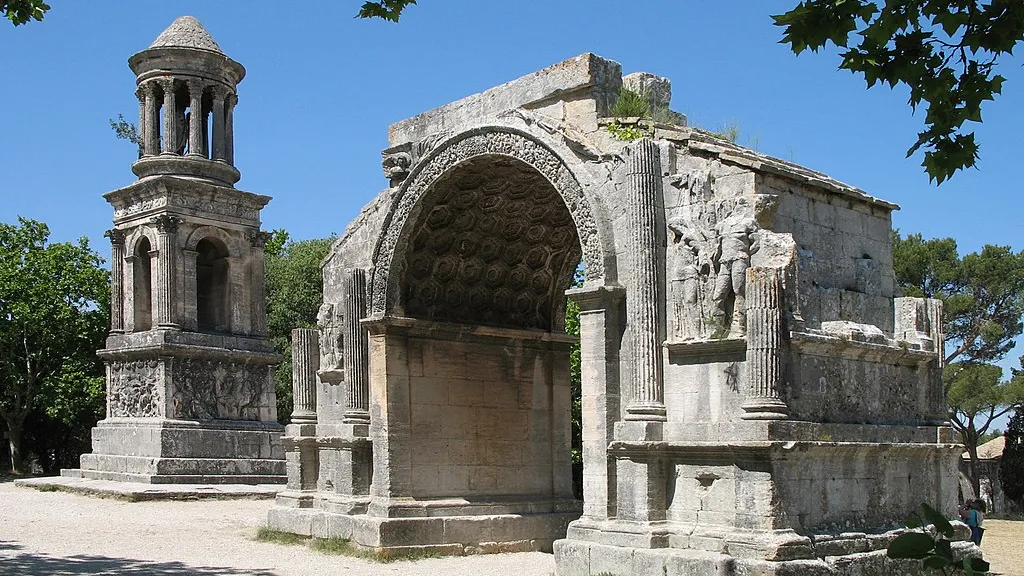
Many monuments of the glorious ancient past have been preserved both in the city and its surroundings. Among them is the Mausoleum, built in the 30s BC, the Arch, constructed during the time of Emperor Augustus. Nearby are the excavations of Glanum, a thriving ancient city destroyed by Germanic barbarians in 270 AD. The Monastery of Saint Paul de Mausole, where Van Gogh lived while ill, has also been preserved. The city has created the Van Gogh Art and Stay Center, which features paintings by the artist and other authors.
Saint-Rémy-de-Provence is the birthplace of Nostradamus, the very same Nostradamus who predicted ‘everything that can be, and even part of what cannot be.’ The most incredible stories are told about Nostradamus: for example, allegedly in his grave, looted during the French Revolution, a plaque was found with the exact date of the desecration of the prophet’s mortal remains. In reality, of course, nothing like that happened; Nostradamus did try to be a seer, that is, a person attempting to predict the future, but he was not a miracle worker. Nostradamus was born into a Jewish family. His ancestors apparently fled from Spain, where Jews were persecuted as non-believers. Notary Jacques de Nostredame, Nostradamus’s father, came from the papal region in Avignon, and his mother was a native of Provence.
The city has a rich cultural and natural heritage, but the Provence surrounding the city can also offer places worth discovering.
Fontvieille – 14 kilometers southwest with its windmills, the 17th-century Church of St. Peter (Eglise St. Pierre), and the Château de Barbegal;
Eyguières – 20 km southeast with the ruins of Château de Roquemartine (dating from the 12th-13th centuries);
Lamanon – 25 km southeast with the largest plane tree in Europe (a natural monument known as ‘le géant de Provence’ – ‘The Giant of Provence’), remains of a cave settlement, churches in the Romanesque style, and two chapels, Saint Jean’s and Saint Denys’);
Orgon – with a country museum where you can see the Virgin Mary from the 14th century and a car museum, whose collection is one of the best in France);
Eygalières – 8 km east, in such harmony of nature and color that it attracted and continues to attract artists and professional photographers, inspiring them to create beautiful works, where it makes sense to spend time visiting the Chapelle St. Sixte. Eygalières looks beautiful when entering from any side, but the northern entrance to the village is particularly attractive, with the village and olive trees in the foreground against the backdrop of the Alps.
To the north, 6 km away, is Maillane – the home of Frédéric Mistral, Nobel Prize laureate and founder of Félibrige (a literary and cultural association for the protection and promotion of the Provençal language Occitan and literature), you can visit his Museum located in the house he bought and where he lived until his death in 1914. The village has a very charming old café.
Verquières – 8 km to the north, do not miss the most beautiful fortified and completely unique church of Saint Vérédème.
Noves – 10 km northeast – the home of Lady Laura, whom Petrarch was in love with, Eglise St. Baudile with a nave from the 12th century.
Graveson – 10 km northwest, where the museum of Auguste Chabaud, one of the masters of Provençal painting of the 20th century, is located, as well as a museum of scents and perfumes (Musée des Arômes et des Parfums), the chapel Notre Dame from the 12th century, the Château de Breuil from the 17th century, and the church St. Michel de Frigolet.
Do not miss the feudal castle from the 12th century in the locality of Boulbon, 15 km northwest, the Romanesque chapel of Saint Julien in the olive grove and Saint Marcellin from the 12th century, a 17th-century mill, the church of St. Anne (Eglise Sainte Anne), and beautiful old houses;
In Barbentane – 18 km northwest, two castles from the 16th and 17th centuries, one of which belongs to the Marquis de Barbentane, the Museum of Old Mills, oil, and flour of Provence.
The Abbey of Saint Michael (Abbaye Saint Michel de Frigolet) – 16 km northwest, whose name comes from the name Ferigoulo, which in Provençal means Thyme. The abbey was founded in the 12th century and was famous for producing an elixir from this plant. The chapel of the Abbey is adorned with 14 paintings with gilded framing made as a vow by Anna of Austria in 1638.
Tarascon – 14 km to the west, its castle is one of the best-preserved in France and was the former residence of Count René of Anjou, King of Provence, the castle houses a collection of remarkable tapestries from Flanders from the 17th century. You can also visit the Cloître des Cordeliers, the Church of St. Martha (Eglise Sainte Marthe), the town hall in the style of Louis XIII, the house of Tartarin, and the Museum of Fabrics (Musée des tissus Souleiado). Outside the city, you can visit the chapel of St. Gabriel from the 12th century (Chapelle St. Gabriel). Across the river from Tarascon, the castle of Beaucaire is a castle where you can see a show with trained eagles and other birds of prey.
And this is far from everything you can encounter while traveling through Provence, not far (by Russian standards) from the town of Saint-Rémy-de-Provence.