











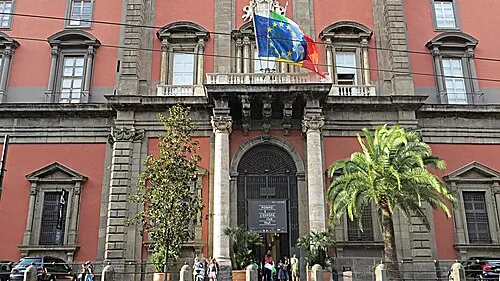
National Archaeological Museum:
The National Archaeological Museum is one of the most interesting attractions in Naples. It houses unique exhibits extracted from the excavations of ancient Italian cities destroyed by volcanic eruptions: Pompeii, Herculaneum, Stabiae. Under one roof, the largest and very valuable exhibitions in terms of cultural history are gathered.
The building, which houses thousands of exhibits, was constructed back in 1615 as a university building. In the second half of the 18th century, the former university was converted to store the exhibitions of the Bourbon dynasty and the Royal Library. After that, the museum expanded rapidly, and the collection gathered by the Farnese family was moved here. A whole collection of unique artifacts was formed during the excavations in the area of Mount Vesuvius, which became the basis for a new exhibition. Gradually, the building was reconstructed and enlarged.
In 1860, the museum became state-owned and received the title of ‘national’. One of the best exhibitions is the collection of sculptures from various eras, however, the most valuable among them are the works of ancient sculptors and architects extracted from the ruins of the destroyed cities. The artifacts discovered during the excavations are classified and divided into several separate exhibitions: Farnese Hall, Sculptures from the Baths of Caracalla, and the Gallery of Emperors.
The archaeological museum is famous for its unique collection of frescoes, as well as floor and wall mosaics, which scholars attribute to the time between the 2nd century BC and 79 AD. Some of the exhibits consist of art objects discovered in the House of the Faun in Pompeii. The mosaic ‘The Battle of Alexander the Great with Darius’ makes a huge impression.
The National Archaeological Museum of Naples is interesting for its beautiful collection of Egyptian antiquities. The core of the exhibitions was formed thanks to the transfer of private collections into state hands. Thus, museum visitors can take a look at one of the largest Egyptian exhibitions in Italy.
In 2000, the museum opened to the public the so-called ‘Secret Cabinet’ – a collection of art objects of erotic and overtly pornographic content. The extensive collection of art and household items indicates that in ancient times, the beautiful body was an object of worship, not shame.
The vast collection of coins occupies 6 halls and unites about 200,000 items. Coins and medals from ancient Greece, Rome, the Middle Ages, and the Renaissance make it one of the largest such exhibitions. It was also transferred to the state by the Farnese family. Among other interesting exhibitions are ancient household items, a collection of gladiatorial weapons, jewelry, religious cult attributes, items related to the history of the Paleolithic, etc.
Open every day except Tuesday, Sunday (schedule may change by the museum), December 24 and 25, January 1, May 1.