






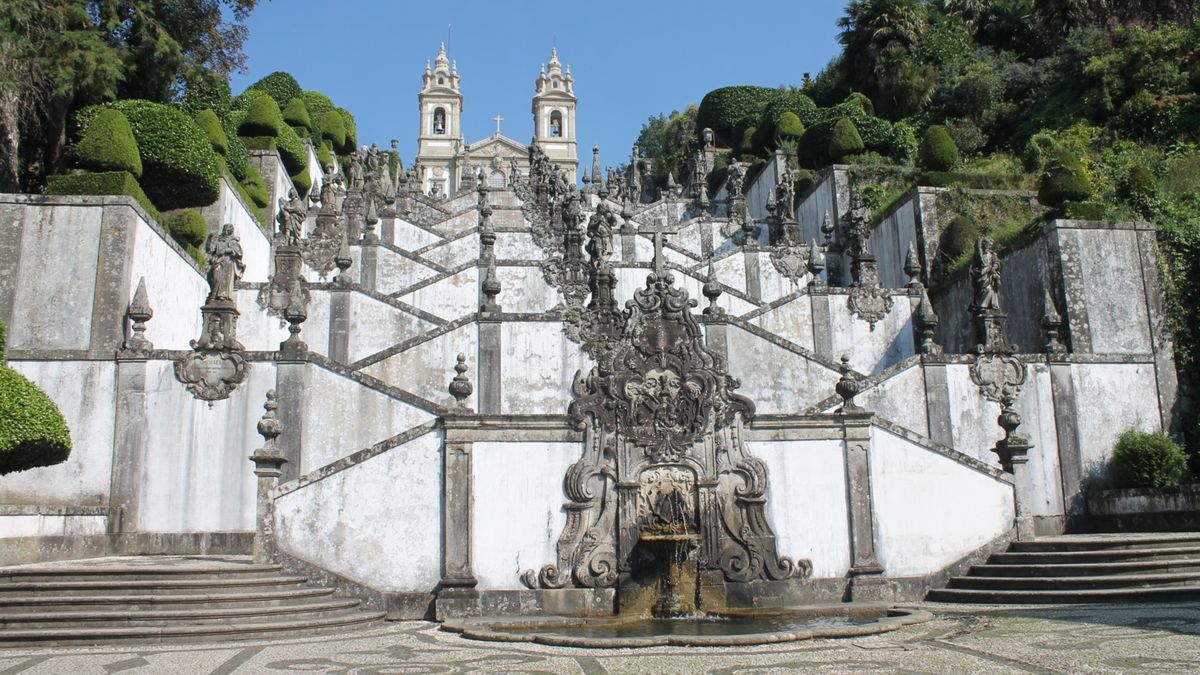
A significant part of Braga’s attractions is concentrated in the small area of the Old Town. The road here passes through Arco da Porta Nova. The first gates appeared here in the 16th century, and in 1772 a Baroque structure was installed in their place. In the center of the Old Town, amidst the Gardens of Saint Barbara, stands the cathedral. Its construction began in 1089 and was completed in the mid-13th century. The Chapel of the Kings, where Count Henrique and Countess Teresa, the parents of the first king of Portugal, are buried, deserves special attention. During our tour in Braga, we will visit not only the cathedral but also the Archbishop’s Palace, which is also located in the Gardens of Saint Barbara. Three wings of this building were built in different eras: the eastern wing is an example of Gothic style, while the western and southern wings are Baroque. Currently, the Archbishop’s Palace houses the archive, the university rectory, and the City Library, which has 10,000 manuscripts and 300,000 books. Braga has many churches. Among the most interesting are Misericordia, built in the 16th century in the Italian Renaissance style, and the Capela da Conceiçao, built at the same time, as well as the 18th-century churches of São João de Souto and Santa Cruz, the facade of which is designed in the Rococo style. The most famous attraction in Braga, the Church of Christ at Golgotha, is not in the city itself but 6 km away. A road leads to it, along which chapels, statues, and fountains symbolizing the 14 stops of Jesus Christ on the way to his execution are installed. A staircase leads to the entrance of the temple, climbing the hillside, surrounded by gardens since the 15th century. Free time for lunch.
After which we will head to the city of Guimarães. One of the main attractions of the city is the Castle of Guimarães (Castelo de Guimarães) or Castelo de São Miguel, which rises on a hill. A large part of the towers and gates of the fortress, built in the shape of a heraldic shield, has been preserved to this day. In the western wing, the Romanesque chapel of São Miguel has survived, where the first king of Portugal, Afonso I, was baptized. A rest in Guimarães will allow you to enjoy the atmosphere of a medieval city, which is associated with several legends. One of them explains the name of the main square, Largo da Oliveira. During your stay in the city or on a tour in Guimarães, you can visit the Palace of the Dukes of Braganza, which was built in the 15th century and belonged to the Dukes of Braganza. The external appearance of this building hints at features of the Burgundian style. The palace remained in ruins for a long time but was restored in the 1930s. Currently, it houses a museum, whose exhibition features furniture, porcelain, faience, and tapestries depicting scenes of the conquest of North African cities by the Portuguese.