







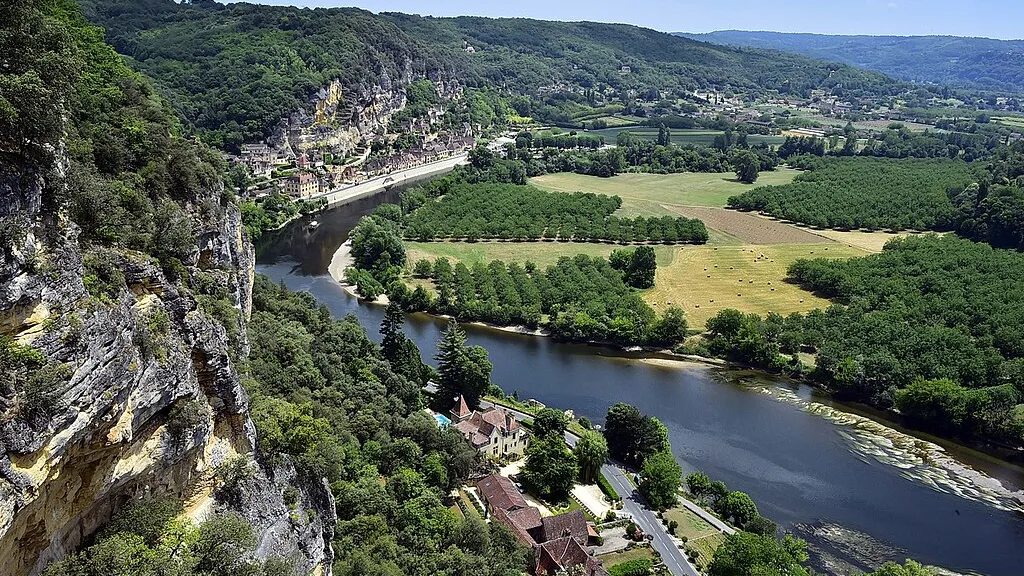
The Dordogne Valley attracts tourists with its soothing beauty, brightness, and diversity of landscapes, picturesque villages, towns, and its world-famous caves and grottos with prehistoric rock paintings.
The Dordogne River is one of the longest and most beautiful rivers in France. It flows in the southwest of France, originating in the Auvergne mountains and flowing into the Garonne, forming a common estuary – the Gironde. Its length is about 500 km, and its basin area is 23,400 sq. km. In the upper and lower reaches, it flows through the Central French Massif, and in the lower reaches, through the Garonne lowlands. It crosses the departments: Puy-de-Dôme, Corrèze, Lot-et-Garonne, Dordogne, and Gironde. It is one of the few rivers with its own tides. This river is very capricious: in the mountains as well as on the plain, it maintains a very fast current, but its intensity is not uniform. Frequent rains in winter and spring snowmelt cause flooding almost every year, which risks turning into a disaster. The improvement of the upper valley by building dams has allowed for the regulation of its flow. This is a navigable river. Sailors have lived by navigation for centuries, despite the great danger. Boatmen used barges: these large boats, which were used mainly downstream, transported travelers and various goods, among which was oak staves for barrel production in Bordeaux. The journey was full of surprises, and sailors required special steering techniques. Once the barges arrived at their destination, they were dismantled into boards and sold.
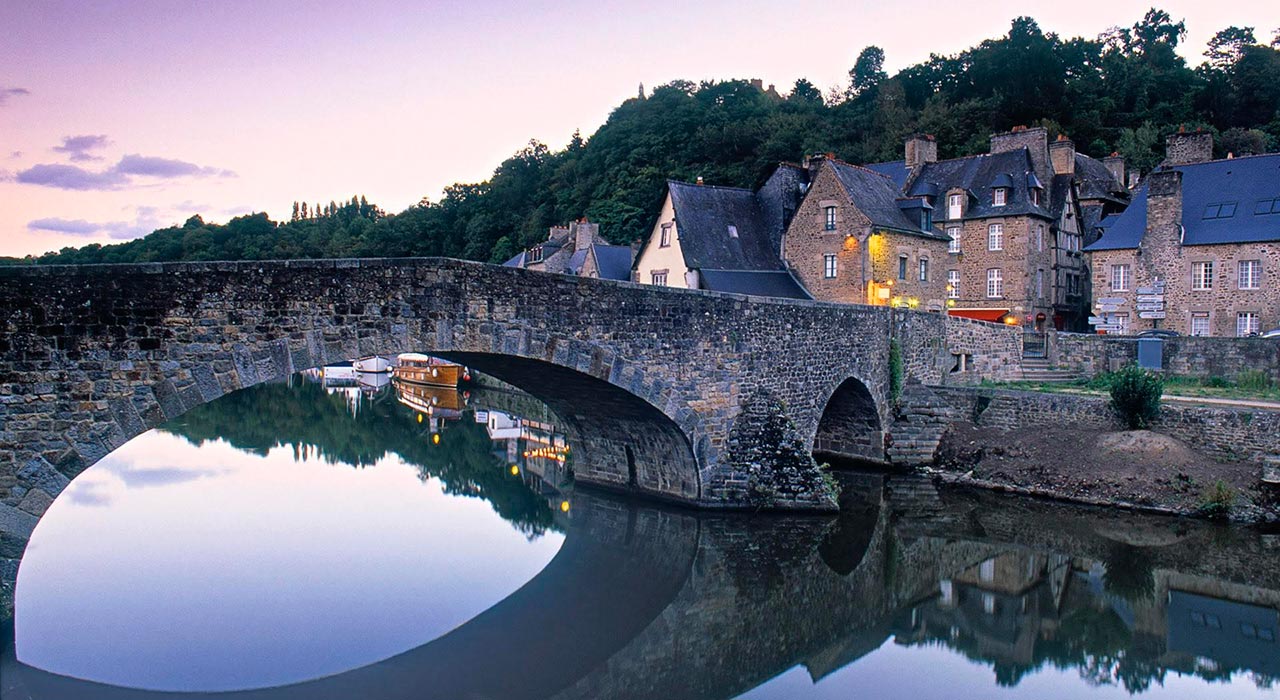
The banks of the river are very picturesque: high steep coastal cliffs – red and gray, riddled with countless caves and grottos, are replaced by low hills, knolls, and plains. Small houses with only a front wall and a front sloping tiled roof cling to the cliffs. Many generations of people have passed in these stone dwellings. The caves and grottos with rock paintings located in the Dordogne department testify to the presence of prehistoric people here about 30,000 years ago. Here lies the famous Lascaux cave – a shelter of Cro-Magnon man with beautiful rock paintings, known to us from school textbooks.
Along the banks of the river stand ancient castles, and extraordinarily picturesque villages and churches are located. For example, the Château de Castelnaud looms over the steep picturesque left bank of the Dordogne, and opposite it, on a hill, is the Château de Beynac, once owned by Richard the Lionheart. These two castles have stood here for almost a thousand years, for a long time being an integral part of the eternal enmity between England and France. In the Middle Ages, a military border ran along the Dordogne: the Château de Castelnaud passed to the vassals of England, while Beynac remained loyal to the French crown. And if the main actors of those distant events have long disappeared, these two castles still continue their endless confrontation, as if challenging the oblivion of time, serving as a good reminder to man of the futility of his thirst for power and vanity.
The diversity and beauty of the landscapes make its valley a tourist route of paramount importance. It begins at the foot of the highest point of the Central Massif – Puy de Sancy. Its fast current crosses the Monts Dore basin and La Bourboule, quickly passing volcanic rocks, which are replaced by Limousin granite. Gradually, the valley widens, reaching the plains of Guienne, covered with vineyards, and then it merges with the Garonne, which is equal to it in power.