






TOUR 1 SCALEA-MARATEA-PRAYA-SAN NICOLA ARCHELLO-SCALEA.
The pearl of northern Calabria.
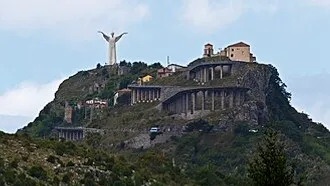
Just 40 minutes from Scalea, in the town of Maratea, there is an attraction that is a true center of attraction for tourists from all over the world – the statue of Christ the Redeemer (Cristo Redentore). The sculpture stands on a high hill, between the sky and the sea, as if floating in the air, at an altitude of 624 meters above sea level. The giant-sized sculpture is made of concrete with a coating of white marble. Such a wonder can only be seen in Rio de Janeiro.
The historic center of Maratea will charm you with its many medieval churches, ancient squares, narrow streets, where even in the hottest weather it is always cool, and at any time of day, the delightful aroma of coffee and sweet pastries fills the air!
On the way back, you will stop in Praia a Mare, where there are amazing grottos created by nature over many centuries. This place has been blessed by the Pope and currently hosts Sunday services.
Next, your path leads to San Nicola Archello, to a panoramic viewpoint with breathtaking views of Dino Island and mesmerizing sea landscapes.
TOUR 2 SCALEA-DIAMANTE-SANTA-MARIA DEL CEDRO-ORSOMARSO-SCALEA.
If you ask a traveler what attracts them most in Calabria, they will surely answer – the people and the towns. It is in such Italian backwaters that the southern temperament of Italians, their cheerful nature, and hospitality are fully revealed. Small, cozy Italian towns are pure charm, with their leisurely existence, where it seems that time itself has slowed down and the bustling age of super technologies is replaced by the same Italian antiquity of days long past.
And you will be able to see this for yourself by visiting Diamante, an open-air museum city. It is famous for its murals – wall paintings. 200 works by artists from all over the world since 1980 adorn the walls of houses. All of them are made in various artistic styles and on various themes. A beautiful seaside promenade, where the symbol of the city is located – a sculpture in the shape of a diamond, (translated from Italian, “Diamante” means diamond).
A medieval church, still in operation, with a beautiful organ, numerous cafes and shops where spicy peppers, limoncello, and cedro liqueurs are definitely sold.
Next, you will move into the mountains, and the marine vegetation will give way to nature very similar to the central strip of Russia. There, where the Pollino National Park begins. But before that, you will visit the Cedro Museum (museo del cedro di Calabria) located in the building of the former prison Carcere dell Impresa – a structure from the 15th-16th century. There you will learn all about this amazing citron – cedro, which only grows in our area, where a certain temperature and humidity are maintained year-round. You will taste liqueurs, syrups, and jams made from cedro, and if you wish, you can buy the products you like. Including magnificent cosmetic products based on cedro oil.
On the way to Orsomarso, we will see how this famous citron grows. You will visit its plantations.
The last stop of the journey is the ancient town of Orsomarso, lost in the mountains, where in ancient times, Basilian monks carried out their monastic feats. It is from here that Saint Luke, Saint Mark, and Saint Thomas came. The place itself lends itself to tranquility and detachment from worldly bustle. The historic center of Orsomarso, the grottos, the Church of John the Baptist, the fortress wall, and the ruins of the baronial castle all remain in memory for a long time.
And at the end of the journey, everyone who wishes can ring the bell of Saint Mark and make one, the most cherished wish, and we hope that the saint will surely help in its fulfillment.
TOUR 3 SCALEA-AVENA-PAPASIDERO-SCALEA.
The name “Papasidero” and the rock painting depicting a bull are remembered by many from the school history textbook of the ancient world. In general, it is not surprising that this drawing made it into the old Soviet textbook – the image of the bull is considered the most famous artifact of its kind in Europe. Who would have thought that this very Papasidero would one day be within direct reach – less than forty kilometers from Scalea!
The road winds through the mountains, revealing breathtakingly beautiful landscapes. You pass several villages, then the town itself, located deep in the Pollino National Park (Parco Nazionale del Pollino), where you will return on the way back and see many historical monuments of the Middle Ages. The Church of St. Constantine (14th century), the Sanctuary of St. Mary of Constantinople (17th century), a Norman-era castle (11th-12th centuries), the Chapel of St. Sophia (11th-12th centuries).
Beyond Papasidero, about 11-15 km away, lies a very small settlement, Avena, where the Grotta del Romito (Grota dei Romito) is located – a site of prehistoric people, a cave with burial sites and rock paintings, and a cave with stalactites. You will also visit the archaeological museum, which houses many ancient exhibits.
TOUR 4 SCALEA-TERME LUIDGIANE-SCALEA.
Since ancient times, these springs have been popular with the Romans. But then there were periods when the springs were forgotten and abandoned. Only in 1850, thanks to Luigi di Bourbon, the springs were “rediscovered,” and the Terme Luidgiane resort was created.
According to legend, the French queen Isabella was cured of infertility by bathing in one of the springs during her visit to Calabria. The Terme Luidgiane remain operational to this day, with hot (47-84 °C) hydrogen sulfide springs enriched with sodium, chlorine, bromine, and iodine, as well as very rare thermomineral mud that successfully treats musculoskeletal diseases, gynecological, respiratory, and dermatological problems.
The advantages of this thermal resort also include its proximity to the sea, so you can combine a beach holiday with beneficial treatment for the body.
The Terme Luidgiane are classified at the level of 1°Super, here sulfurous water with the highest sulfur content in Italy (173 mg/l) is used.