







This route offers the opportunity to get acquainted with the most famous monuments of 15th-century Venetian architecture. “Transforming something useful, necessary, functional into something beautiful is the task of architecture,” asserted Karl Friedrich Schinkel. The Doge’s Palace in Venice is a vivid example of the great Gothic architecture of this city, a kind of Bach fugue in stone, making one freeze and contemplate. It is precisely with a discussion of its structural system, its purpose, its decorations that we begin the story.
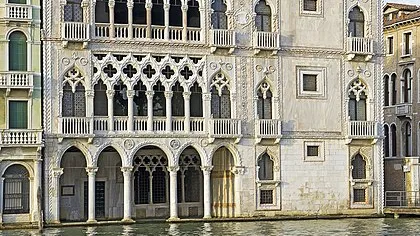
Visiting masters from Lombardy and Tuscany gained fame as skilled architects, fulfilling orders for the construction of Venetian palazzos (palaces), whimsically combining Northern European and Eastern (Arab) elements of architectural styles. The fashion for the East in Venice was organic and natural. Therefore, the architectural style of Venice, with its airy arcades and pointed arches, closely resembling Arab-Muslim architecture, received a new definition – “Venetian Gothic.”
You will be offered a visit and inspection of 15th-century monastery churches: St. John and Paul, the Cathedral of Santa Maria Gloriosa dei Frari, the Church of Madonna dell’Orto, the Church of Santo Stefano.
Winding through the narrow Venetian calle (streets), you will certainly notice how this peculiar Gothic style has become the emblem of Venice. The Palazzo Mastelli on Misericordia, Ca’ d’Oro on the Grand Canal, Ca’ Foscari, Palazzo Soranzo Van Axel, and others. After the guide’s explanations, they will come to life in your eyes, revealing their history and secrets.
The style of local Venetian Gothic found its vivid expression in both sculpture and painting. You will undoubtedly find it interesting and informative, even at the level of a curious observer, to get acquainted with the works of the Vivarini workshop, Giovanni d’Alemagna, and others.