






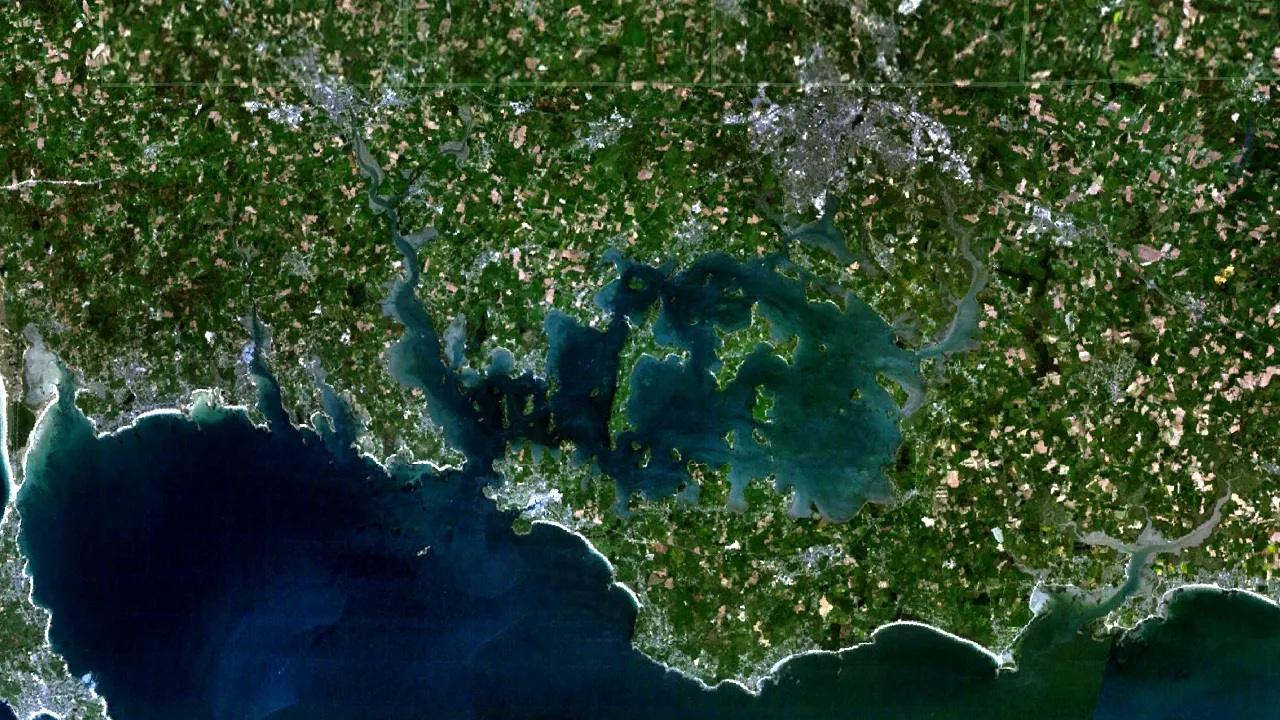
Morbihan – translated from Breton – means “little sea”. The unique configuration of the bay, a large influx of fresh water, strong currents, and a warm microclimate have created its unique landscape over the centuries.
“Little sea”, covering an area of 12 thousand hectares, is almost entirely surrounded by land. The numerous islands of the bay are the peaks of hills that have submerged due to rising ocean levels. Powerful currents rage here, and the tide floods the small isthmuses connecting the islands.
These islands are home to the most skilled sailors of Brittany, who have been accustomed to navigating the labyrinths between tiny patches of land since childhood. People settled in these regions as far back as the Stone Age. Evidence of this is provided by numerous megaliths (prehistoric structures made of large stone blocks) along the shores of the bay.
In the 1st century BC, the Veneti lived here, who were the most powerful people of the Breton Peninsula, Armor (Armorica – Normandy and Brittany among the ancient Celts), and possessed an invincible fleet. However, they were defeated by Caesar: he attacked the Veneti during a calm when their ships were defenseless, and the Romans were on flat rowing boats…
According to legend, in the famous Brocéliande forest (now known as the Paimpont forest), located near the town of Vannes, fairies lived (in this forest, as legends say, many wonders occurred, knights of the Round Table fought duels, and according to tradition, Merlin’s grave is located here). Upon leaving the forest, they shed so many tears that an inland sea arose – the Morbihan bay. The fairies threw their flower wreaths into the water – and many islets appeared in the bay…
Any of these islets can be reached by boat, yacht, canoe, or any other floating means. On the Island of Monks (Ile aux Moines), you will be amazed to find that at 47.5° north latitude (which roughly corresponds to Rostov-on-Don and Astrakhan), oranges, palm trees, and mimosa can grow. All thanks to the microclimate – it never drops below zero Celsius here.
On the islet of Gavrinis (Ile de Gavrinis) is a whole complex of dolmens (these are ancient mystical structures, estimated to be 7-8 thousand years old), connected underground (this structure is called a “kern” by scientists). The walls of the kern were painted by ancient people with numerous mysterious symbols.
On the shore of the bay is the administrative center – the city of Vannes, which is considered one of the most beautiful cities in Brittany. It is surrounded by thick fortress walls with fairy-tale round towers and tiled roofs. Here is also one of the most famous megalithic monuments in Europe – the city of Carnac. Megalithic structures – dolmens, kerns, menhirs – are found everywhere in Morbihan.
In the spring and summer months, lovers of maritime holidays and festivals flock to the shores of the bay. The Scarlet Sails festival brings together ancient sailing ships, carefully restored by their owners. From the 14th to the 20th of the beautiful month of May, the Maritime Festival “La semaine du golfe” is held. The “Week of the Bay” of Morbihan has been celebrated for several years. Traditional and classic sailing ships, as well as historically reconstructed ships, participate in the festival in Seven Mixed Fleets. The Race of the Seven Fleets follows the rules of alternating 14 ports located at 4 different ends of the bay, and all this is accompanied by water-motor competitions, regattas, and night fireworks.
Morbihan is rightly considered one of the five most beautiful bays in the world…