






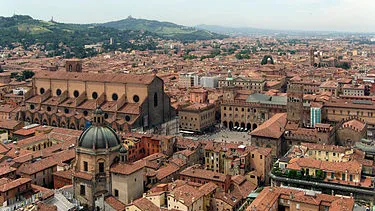
Presumably, the settlement was founded in the sixth century BC by the Etruscan king Fero, who named the city after his daughter – Felsina. Thanks to its favorable location, fertile lands, and trade, the settlement quickly developed. After some time, it was captured by the Boii (a Celtic tribe) and since then the city has been called Bononia. The city survived the fall of the Roman Empire, fragmentation, and the establishment of a new state, as well as persecution of Christianity.
The tour begins at Piazza Maggiore – the center of political and economic life in Bologna. The square is adorned with the Fountain of Neptune, created by the 16th-century sculptor Giambologna;
The Palazzo Comunale or Palazzo Accursio – named after one of its former owners, the renowned lawyer D’Accursio. The apartments of the Papal Legate were also located here. This building now serves as the Municipality.
Climbing the famous Bramante staircase, one can see the Farnese Chapel and the Farnese Hall, as well as the State Collections of Paintings.
The Hall of the Stock Exchange – closed on Sundays and Monday mornings, where a new multimedia city library is currently located, under a glass floor where archaeological excavations of the Roman forum are clearly visible.
The Palace of King Enzo – named after King Enzo (son of Emperor Frederick II), who was captured by the Bolognese in 1249 during the battle at Fossalta. This palace served as his ‘golden cage.’
The Palazzo Podestà – an administrative building from the 13th century, rebuilt in the 15th century by the architect Aristotele Fioravanti (who built the Assumption Cathedral of the Moscow Kremlin). This is a masterpiece of engineering, where the Tower does not rest on the ground but on the pilasters of the vault.
The Basilica of Saint Petronius – dedicated to the patron saint of the city and is a symbol of Bologna’s independence – The church was founded in 1390 in honor of Bologna’s victory over the Pope. Built according to the design of architect Antonio di Vincenzo. Inside the Basilica, there are 22 chapels with frescoes and various works of art, as well as the longest meridian in the world.
The Palace of Notaries – built in 1388 by architect Antonio di Vincenzo, the building belonged to the Guild of Notaries.
The Palace of Banks – where the offices of banks were located and currency exchange took place in the Middle Ages. Built according to the bold design of Jacopo Barozzi, nicknamed Vignola, in the second half of the 16th century. The facade rests on 15 arches that overlook the Medieval market near the square.
The Portico of Avalone – one of the many porticos in Bologna, which stretches for 38 km throughout the city.
The Palace of the Archigymnasium – the building of the first university in Bologna, with a unique anatomical theater; it also houses the city library.
The Two Towers – Asinelli and Garisenda – are symbols of the city. In Medieval Bologna, there were about a hundred towers and tower houses that belonged to the main families of the city. The height of the tower indicated the power of its owners.