







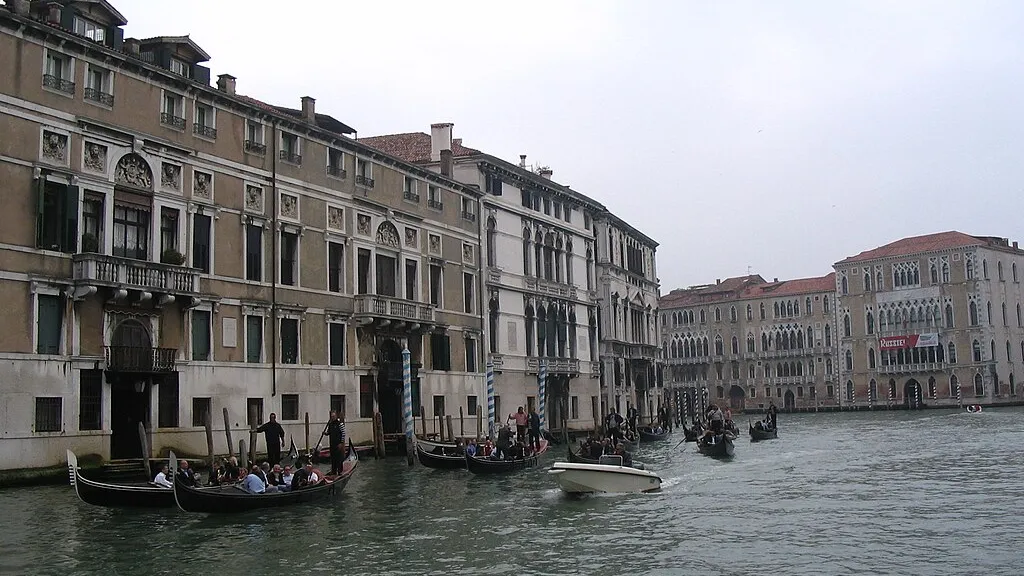
Palazzo Mocenigo:
A complex of four adjacent palaces from the 16th-17th century in Venice. Located on the Grand Canal. The two middle palaces are absolutely identical.
An amazing story is associated with the Museum of Palazzo Mocenigo. Once, this palace belonged to one of the most famous and respected noble families in the city, the Mocenigos, who settled in Venice many centuries ago. Giovanni Mocenigo was once a patron of Giordano Bruno, who stayed in this palace. Later, Giovanni Mocenigo wrote a denunciation to the Council of Ten, accusing Bruno of heresy. The Venetian Senate complied with the papal verdict and agreed to extradite Bruno to Rome, where he was burned in 1600.
Situated right above the waters of the Grand Canal between the Rialto Bridge and St. Mark’s Square, Palazzo Mocenigo takes its guests back to the glorious times of the Venetian Doges’ reign. Preserved in all its splendor, a luxurious Italian garden surrounds a quiet spacious courtyard leading to the Gothic-style building located deep within – the family residence of the Mocenigo family.
Many famous people of that era were guests of this palace. Among them was the Prince of Savoy, who stayed at the Palazzo in 1547, and the famous Lord Byron, who wrote several immortal poems in 1880 in the tranquility of these idyllic places. The palace building was constructed according to the laws of Gothic style around the 16th century and is located in a quiet corner of the Santa Croce district. In the early 17th century, it was rebuilt and became the most beautiful residence of the family in Venice. The owner of Palazzo Mocenigo dreamed that his ancestral nest would be a Museum that would tell citizens and tourists about the history of the national costume. His dream came true in 1985 when the Museum opened in the gifted building, with its main exhibits being fabrics and costumes. The lavish details of the interiors are mesmerizing – mosaic marble floors, high baroque ceilings, colossal fireplaces and columns, weightless sparkling Murano glass chandeliers, walls upholstered in silk and brocade – an unparalleled atmosphere of the grandeur of a bygone era. In 1945, Count Alvise Nicolo Mocenigo, the last descendant of the family, donated this palace to Venice to be used “as an art gallery, in addition to the Correr Museum.” After a quite exemplary restoration, Palazzo Mocenigo became part of MUVE. The reconstruction project belongs to the famous scenographer Pier Luigi Pizzi, and part of the furniture and paintings were shared by the Correr Museum and the Ca’ Rezzonico museum. The second part of the exhibition features various perfume bottles and the history of perfumery.
Open every day except Monday, December 24, January 1