






Excursion to the Phlegraean Fields: (continuation):
The Stufe Antiche are two brick-lined caves that were used as baths. They are called “Purgatorio” and “Inferno” (“Purgatory” and “Hell” respectively) due to the temperature difference. Currently, they are no longer used as baths.
The Archaeological Park of Cuma – the ancient Cumae are located at the northern border of the Phlegraean Fields. They were founded in the 8th century BC by a group of Greek colonists from Chalcis. Here, an ancient Roman crypt (an underground gallery), a grand bathhouse, and an amphitheater were also discovered. Additionally, numerous burials from the ancient Roman and Greek periods. Near Cumae is the Arco Felice, a viaduct built during the time of Domitian, connecting Pozzuoli with the road to Rome.
The Cave of the Sibyl – a long gallery was discovered by the archaeologist Maiuri in 1932. In it, the prophetess Sibyl received visitors to whom she predicted the future.
The Temple of Apollo – appeared on this site as early as the 6th century BC, but it was dedicated to Apollo only during the era of Ancient Rome. In the central part of the temple was a sacred room divided by two rows of columns, and to the south of the temple, there are two more small rooms. In the 5th century AD, the temple was transformed into a Christian basilica.
The Temple of Jupiter – the largest temple of the acropolis is traditionally attributed to Jupiter. It was probably built at the end of the 6th century BC.
The Forum Baths – the baths were built in the center of the city, southwest of the forum. The building of the baths was richly decorated, as evidenced by the preserved decorative elements: marble slabs, porphyry cornices, black-and-white mosaics.
Lake Averno – still water, a harsh landscape of shores surrounded by wooded hills: this is how, according to ancient people, the entrance to the underworld looked (“Aeneid”, “Odyssey”). Even the name of the lake translates from Greek as “without birds”. In the 1st century AD, Emperor Augustus decided to establish a military port here, naming it Portus Julius, connecting the two lakes to the sea via canals. But very soon the water body became shallow, so the naval base moved to Misenum, and villas and baths appeared on the shores of the lake.
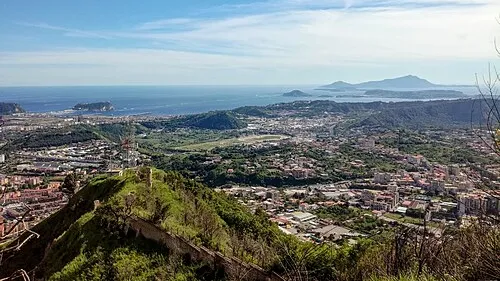
The Oasis of Nature Monte Nuovo – formed as a result of the eruption of 1538, when a hill formed around the crater (between Lake Lucrino and Arco Felice). From here, panoramic views open up, and it is quite possible to walk to the top. From above, views extend from Posillipo to the Bay of Pozzuoli. If you walk around the edge of the crater, the lakes Lucrino and Averno with the islands of Procida and Ischia in the distance become visible.