






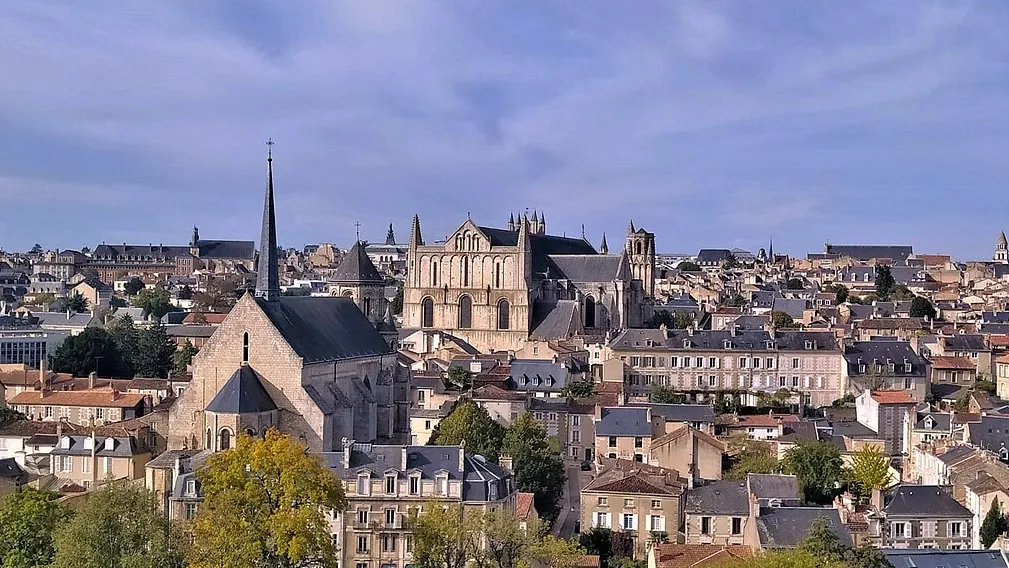
Poitiers (ancient Limonum) – a city in France, on the Clain River (Loire basin) – the main city of the historical region of Poitou and the administrative center of the Vienne department, a fairly large and lively city. It arose as the city of Limonum on the site of a fortress of the Celtic tribe of the Pictones during the Gallo-Roman era. It was one of the most important Roman metropolises in Aquitaine.
Poitiers is rich in monuments of Celtic, Roman, and medieval architecture: the ruins of the Roman aqueduct have survived, and until 1857, the Roman arena could still be seen. On the other side of the Clain is the so-called ‘Pierre levée’ – a dolmen (this is one of the types of megalithic monuments, made of large stones or stone slabs, resembling stone tables (hence the Celtic name for them, dolmen, in Brittany) and previously recognized by archaeologists as altars or sacrificial sites of druids, but in reality, they were stone tombs from prehistoric times), associated with many ancient legends and superstitions.
At the dawn of Christianity, a chapel of John the Baptist (Baptistere Saint-Jean) was built here – the oldest example of Christian architecture in France, now a museum of Merovingian art (a conditional name for the art of several regions of France (mainly northern and central), united in the 5th-8th centuries by the Merovingian state, which used the traditions of late antique, Gallo-Roman art, as well as the art of the barbarians). Over the centuries of its existence, the chapel has ‘grown’ into the ground. In the center of its hall is an octagonal font. In the 11th-12th centuries, during the heyday of the pilgrimage route to Saint Jacques de Compostelle, numerous Romanesque churches were built in Poitiers and its surroundings.
This period is associated with the main attraction of the city – the church of Notre Dame la Grande (Notre Dame la Grande 11th-16th centuries). Every summer evening, the original appearance of the temple is reproduced through artistic laser projection: biblical characters come to life before the viewer. Noteworthy are the Romanesque Cathedral of Saint Peter (Cathédrale Saint-Pierre) in the episcopal quarter, the construction of which dates back to the late 12th century, the church of St. Radegund – Ste.-Radegonde (11th-14th centuries) with an underground chapel (which houses the tomb of Queen Radegund), and Saint Hilaire le Grand (11th-12th centuries). The palace of the counts of Poitou (12th-15th centuries) is also worth noting.
Nearby is the oldest abbey in the West, Liguge (Liguge), the medieval village of Nouaille-Maupertuis with a Romanesque church built on the site of a Benedictine abbey, which houses the tomb of St. Junien.
It was here that battles took place from the 9th to the 18th centuries that determined the history of France for many centuries. At the end of the 5th century, Poitiers was the residence of the Visigoth king Alaric II. In 507, the Frankish king Clovis defeated the Visigoths at Vouillé near Poitiers, which ensured the capture of southwestern Gaul by the Franks. The city became a major center of the Frankish kingdom. In 732, in the locality of Moussais between Poitiers and Tours, the Frankish heavy cavalry of Charles Martel surrounded and defeated the Arab army that had invaded from Spain, forcing it to retreat to the Pyrenees and stopping the advance of the Arabs into Europe, after which Poitiers became the main city of the county of Poitou.
Museums: fine arts (mainly French school), Sainte-Croix (Sainte-Croix) – rich archaeological collections and a collection of painting and sculpture, modern scientific and technical. Botanical garden, picturesque parks of Blossac (Parc de Blossac) and Smarves…
In Poitiers was the Aquitanian residence of the Order of Hospitallers. The trials of the Templars and Joan of Arc took place in one of the halls of the Palace of the Dukes of Aquitaine (counts of Poitou), now the Palace of Justice (built in the early 13th century, significantly expanded and rebuilt in the 19th century).
Every year, a festival on the theme of the Middle Ages is held here, and battles of the Hundred Years’ War are reenacted. To the south of Poitiers are the abbeys of Saint-Benoît and Fontenay le Comte, where François Rabelais took monastic vows at the age of twenty-five.
The towns surrounding Poitiers – Châtellerault, Chauvigny, Saint Savin…, are also worthy of attention from the curious tourist as guardians of invaluable fragments of ancient culture, history, and architecture.
Seven kilometers from Poitiers is the Futuroscope park. It is a true paradise for dreamers and lovers of fantasy: you can peek into the future thanks to numerous attractions and shows with light, music, three-dimensional space, and computer games. An exciting journey through space, time, and the world of human values and knowledge.
The symbol of Futuroscope is the white sphere on the glass pyramid – Solido. The sphere is built based on the proportions of the golden section. The park is dedicated to visual technologies: dynamic, three-dimensional, popular science, adventure, and simply interesting cinema.
The European Park of New Audiovisual Technologies Futuroscope is a place for walks and relaxation for the whole family. Here, nature and architecture merge to create a unique space. The spheres, cubes, and mirrors located on an area of 100 hectares enter into perfect harmony with water, trees, and flowers, creating original and amazing perspectives.