






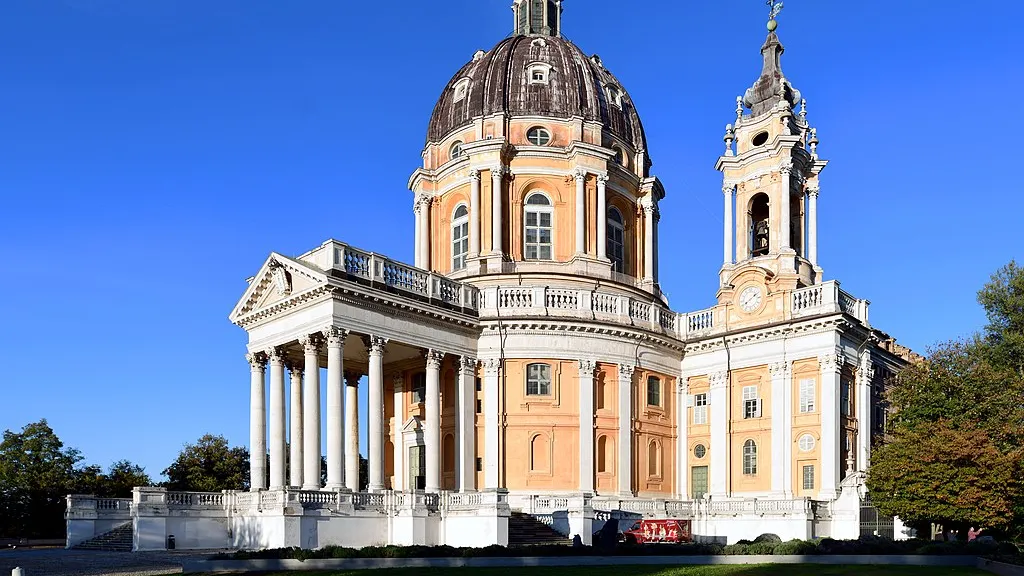
From the top of the Superga hill, the basilica rises above Turin, reminding of the victorious battle of 1706 and the creation of Piedmont as a kingdom. Since its construction, the basilica has been the burial place of members of the House of Savoy until the 1990s. After visiting the church, one should visit the monastery’s refectory, the walls of which are covered with portraits of popes throughout the ages. The descent into the crypt to the marble tombs, richly decorated in the late Baroque style, contrasts with the ascent up the spiral staircase to the dome of the temple, from where a breathtaking view of the Piedmont plains and the Alps opens up.
Ten kilometers from the city of Turin, at the very top of the Superga hill, from which it got its name, is the Superga basilica – a place where history and legend converge. This basilica was built due to a vow, it is the church where representatives of the House of Savoy were buried, it is the place where a terrible tragedy occurred decades ago.
The decision to build the basilica belonged to Vittorio Amedeo II and was made at the climax of the duke’s reign – during the French siege in 1706.
Two hundred and fifty years after the French siege of Turin, on September 7, 1956, a solemn mass was held in Superga to honor the memory of all the fallen soldiers of that time. It is worth noting that consuls from Italy, Spain, Austria, and France were present at this service – representatives of the countries that fought for the small town in the north of the country at that time. The external facade and interior decoration The construction of the Superga basilica began in 1717 and was completed 14 years later.
At the main entrance, the Superga basilica greets visitors with an elongated hall decorated with eight Corinthian columns. Turning right upon entering the temple of the Virgin Mary, one can climb the staircase to the turret, from where a stunning view of Turin, the Po River, and a whole range of Alpine peaks opens up.
To the left of the altar of the Superga basilica is a chapel, which is a favorite place for pilgrims: it is here that the duke vowed to build the basilica in honor of the Virgin Mary. This historical moment is depicted in one of the frescoes that adorn the chapel. The same story is captured in one of the paintings of the city church of Saint Christina.
Under its arches, Superga hides a royal mausoleum, where the bodies of many princes and kings of the illustrious House of Savoy rest. This place has served as a tomb for members of the noble family since 1731, and the first grave was that of Vittorio Amedeo II.
The central chapel is a true museum of stunning sculptures, as well as a picture gallery with numerous images of all the Popes who became heirs of the Holy See of the Catholic Church after Saint Peter.
On May 4, 1949, the Superga basilica witnessed a terrible disaster. The pilot of the plane, which was carrying players from the super club “Torino” flying to a match against “Benfica”, lost spatial orientation due to poor visibility and hit the basilica’s fence, the aircraft sharply turned from the impact and crashed into the ground at high speed. All passengers, among whom were not only footballers but also three well-known journalists and technicians servicing the plane, died. The tragedy not only claimed the lives of the most talented athletes but also crushed the spirit of all Italians.
Now inside the Superga basilica is a small museum, and nearby, at the site of the plane crash, a memorial has been erected in memory of the legendary team that lost the most important match of their lives – a match with fate.