








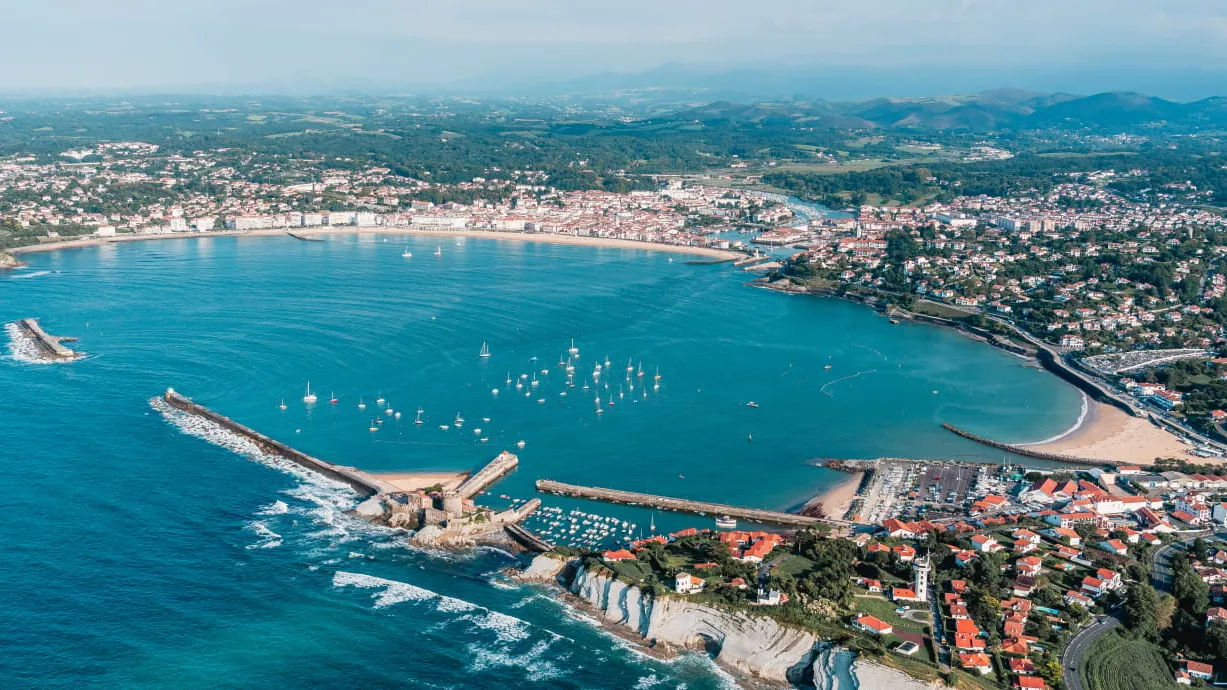
This ancient seaside town is located in the depths of the round, calm bay of the Bay of Biscay, so there are almost no large ocean waves here and swimming is very comfortable. Around the beach, a high dam runs in a semicircle along the bay, from which bridges are thrown to the villas and houses surrounding the bay. The climate in Saint-Jean-de-Luz is maritime. The summer is warm: the average temperature in July is 20.6° C; the water temperature reaches 20-22° C.
In the 11th – 13th centuries, the town was known as a stop for whaling ships. Currently, whales have been replaced by tuna, anchovies, sardines, and octopuses, which are fished by local fishermen. At the beginning of July, a tuna festival is held in the town – cheerful, carefree, with an abundance of fish prepared in various recipes. Around the main square of the town, you will find the best restaurants on the Basque coast, where you will be offered all kinds of fish delicacies.
Here, in the Louis XIV square, musical concerts are held during the summer months, including performances by the Basque choir and a jazz festival.
The central part of the town is a vivid expression of the Middle Ages, with Spanish and Moorish influences felt in the architecture. The main historical landmark is the largest cathedral in the Basque Country – the Cathedral of Saint John the Baptist (Eglise Saint-Jean-Baptiste), where in 1660 Louis XIV married Maria Theresa of Spain. This 14th-century cathedral has a three-story gallery and is considered one of the most beautiful Basque cathedrals. Next to the cathedral are two houses, one of which – the ‘House of the Infanta’ – was where Maria Theresa stayed before her wedding, and the other – the ‘House of the King’ – was where the young Louis XIV stayed.
In the town, you can visit the Wax Museum (Musée Grevin), and nearby is the Urtiubi Castle with a collection of 16th-century furniture and carpets.