








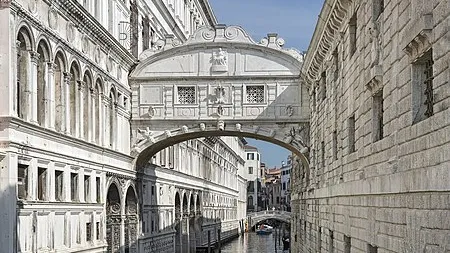
For lovers of mysteries and secrets, the attic rooms of the Doge’s Palace have long been well known, primarily the “lead prison,” which gained fame as the most notorious place of imprisonment in Europe after the escape of Giacomo Casanova. But the puzzles and mysteries of the Doge’s Palace do not end there. Relatively recently, the infamous wells – “Pozzi” – were opened for visits. On the first floor were located the damp and barren prison cells of the Doge’s Palace. When it was established in the late 16th century that more prison cells were needed, the Venetian government began construction of a new building called Prigioni Nuove (New Prisons). The famous Bridge of Sighs was built as a passage between the palace and the prison and is accessible through the Sala del Maggior Consiglio on the second floor.
After restoration, the most terrifying cells of the Venetian prison, managed by the Council of Ten – Consiglio dei Dieci, became available for viewing. The Council of Ten was a spy service created in 1310 after it became known that Doge Falier was plotting to overthrow the government. The Council met in this separate room to monitor other branches of power (for example, by reading incoming and outgoing mail).
The work of Veronese adorns the ceiling, and there is a large painting by Tiepolo “The Gifts of Neptune, Giving Venice.” Immersed in the eternal darkness of the 19th century, stone bags ranging from 5.5 to 12 sq.m. brought about a quick death for the weak and drove the stronger to frenzy and madness. Those destined to languish in these dungeons immortalized their experiences on the walls of their cells: from banal inscriptions and lewd drawings to true masterpieces.
Everything seen, accompanied by stories about the fates of the prisoners, convinces one of the justice of the Venetian system of punishment and rehabilitation.