






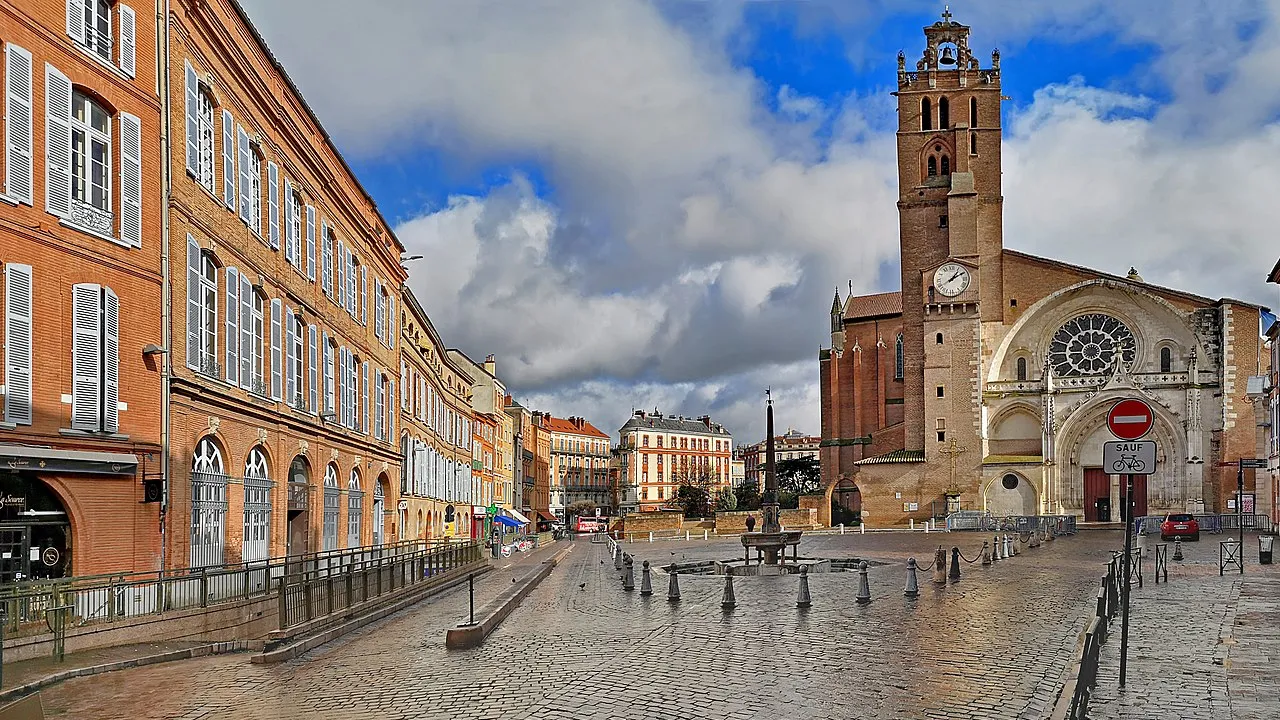
Toulouse is located on the Garonne River. It is one of the largest cultural, scientific, and industrial centers in France. It is the fifth most populous city after Paris, Marseille, Lyon, and Lille. The Southern Canal runs right through the city, connecting the Mediterranean Sea and the Atlantic Ocean since the 17th century.
Toulouse was founded in the 4th century BC by the Celtic tribe. The good climate and advantageous geographical location attracted the Romans here in the 2nd – 3rd centuries. In the 5th century AD, the city became the capital of the Visigoth kingdom. Throughout French history, Toulouse has been a coveted prize in the struggle for power in the southwestern part of France.
The golden age of Toulouse begins in the 15th century when wealthy merchants start building mansions from red brick, setting the main color tone of the city’s architecture for centuries. The city’s new flourishing is associated with the reign of Napoleon Bonaparte, when many new buildings, boulevards, and roads appeared in the city.
Until 1789, Toulouse was the capital of the province of Languedoc. Today, Toulouse is the center of the economic region of the Southern Pyrenees, one of the largest regions in France. Famous ski resorts in the Pyrenees, known for both winter skiing and summer landscapes, are located 110 km from the city.
Today, Toulouse is not only a city with a historical past but also a center of high technology and the aviation industry in France.
Toulouse is considered one of the most stylish cities in the south of the country. Here’s how the French describe it: “Pink at dawn, red at noon, and purple at dusk.” There are many gardens and squares, unexpected angles, and views… The city is very diverse, with medieval times blending with the Renaissance and modernity, history with comfort.
The architectural gem of Toulouse is the Basilica of Saint Sernin (La Basilique Saint Sernin – the largest Romanesque church in Western Europe), located in the city center along with the Capitol Square featuring the City Hall and theater, the Jacobin church and monastery (dating back to 1275), as well as numerous private mansions from the Renaissance era.
In addition to its unique, enchanting architecture, Toulouse has good museums. For example, the Museum of the Augustinians (Musée des Augustins), located in the church of the Augustinian monastery in the city center, is famous for its Romanesque and Gothic sculptures, as well as its exhibition of 19th-century French painting.
In 1997, an aviation and space museum opened in Toulouse.
Toulouse has more than 20 organs – more than any other city in France, which is why the city hosts an international organ festival.
There are extremely many students here, and perhaps it is the student body that creates such a lively and free atmosphere in Toulouse.
To see the city well, it is best to walk around it. The largest shops are located near Capitol Square.
Toulouse is famous for having the longest life expectancy in France and its special local cuisine. Far beyond the city, the foie gras made from goose or duck liver, duck fillet, bean stew with poultry or meat baked in a clay pot, and of course, “Frontonnais” – the famous wine of this region are well known.