






Verona served as a base for the control and expansion of territories in the ancient Roman era and has maintained an important role as a fortress over the centuries, up to the unification of Italy. The 10 km of Verona’s city walls tell the story of the city’s two-thousand-year history and demonstrate the development of military and architectural technologies:
The monumental gates of the 1st century BC – Porta Borsari are ancient Roman gates that served as the entrance to the city of Verona. This three-tiered white stone structure, built in the 1st century AD, still impresses with its preservation. Porta Leoni – the original name of the gates remains a mystery, in the Middle Ages they were called Porta San Fermo, and the current name was acquired from the sculptures of lions that adorned the tympanum of the nearby tomb. The Porta Leoni gates adjoin a brick wall, which is a fragment of the ancient Roman gates from the 1st century BC.
Underground tunnels – beneath the Arena of Verona, the ancient Roman amphitheater, there is a whole system of underground galleries and corridors designed by ancient engineers, as well as a huge number of other tunnels under the entire Verona.
The medieval castle – Castelvecchio – is one of the most remarkable examples of medieval architecture in Italy. It was built between 1354 and 1376, when Verona was ruled by the Scaliger dynasty, also known as the Scaligers. The castle is built on the foundation of a Roman military fort.
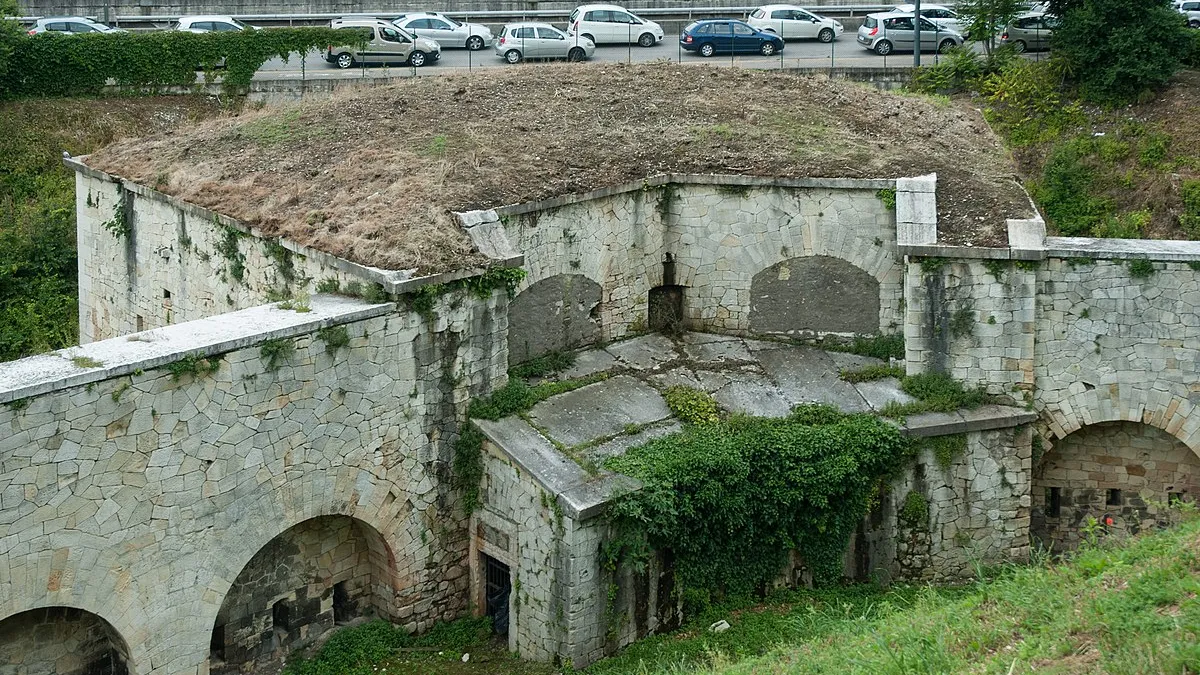
Bastions – part of the bastions that once surrounded the entire city has been preserved. The bastions were constructed around Verona between 1520 and 1557. Over time, they were rebuilt several times, following the development of fortification science. The last major reconstruction was carried out between 1833 and 1845 by the Austrian engineer Franz von Scholl on the orders of Field Marshal Radetzky. The bastions of Verona did not participate in serious battles. During World War II, their casemates and sally ports were used as bomb shelters. The bastions are located near the train station, between the gates Porta Nuova and Porta Palio. Together they form the park Parco delle Mura (“park on the walls”).
The Lamberti Tower – the tallest building in Verona (84 m high) appeared on the city map in 1172 thanks to Bozeno di Lamberti, a representative of a respected family in the city. In the 12th century, those who were not financially constrained built monumental residences for themselves, reliable and protected, resembling fortresses. This tower was built in the same principle in the Romanesque style, inheriting the name of its creator Lamberti.
For those who want to delve deeper into this topic beyond the city, the 19th-century Austrian fortress wall can be visited, built during the time of the Austrian government: there were 28 fortresses – 4 km from Verona.
The defensive architectural complexes of Verona are among the best preserved in Europe.