







The route includes the classic tour “Colors of Bologna” and a visit to the Sanctuary of Saint Luke, which serves as a kind of lighthouse on land for Bolognese returning home. If the Two Towers are considered symbols of the city, then the Sanctuary of Saint Luke is Bologna’s “icon.” Here, the Blessed Madonna of Saint Luke is venerated.
The Madonna di San Luca on the Guard Hill is a well-known pilgrimage site in Bologna, and ordinary tourists also strive to see the sanctuary, which has become one of the symbols of the city. In the 12th century, a hermit brought the icon of the Mother of God, created by the evangelist Luke, from the Church of Saint Sophia in Constantinople to a hermitage here. It was inscribed “Guard Hill.” The sanctuary stands at the top of the wooded Guardia hill, southwest of the center of Bologna. One of its unique features is the arcade with more than six hundred arches leading to the temple. Its total length is almost 3.8 km, connecting the church with the city. Additionally, the arcade serves as a shelter for the solemn procession that annually, starting from 1433, carries the icon of the Byzantine Madonna with the child to the San Pietro Cathedral in the city center on Ascension Day. In 1930, a funicular with a single pylon was built. However, it caused strong discontent among devout believers who believed that pilgrimage to the sanctuary should only be done on foot. In 1976, the lift was closed due to the increased flow of vehicular traffic.
The sanctuary at the site of the current Church of San Luca has stood for over 1000 years. In the 12th century, a pilgrim from the Byzantine Empire brought the icon of the Mother of God to Bologna from the Church of Saint Sophia in Constantinople. In 1160, the icon was placed in a small chapel at the top of the hill, cared for by two women, and by 1193, a full-fledged church began to be built at this site.
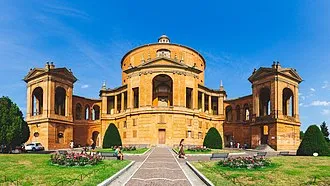
The current church was built by architect Dotti between 1723 and 1757 and replaced an earlier structure from the 15th century. The two tribunes outside were completed according to the designs of Dotti’s son Giovanni Giacomo in 1774, and since then, the appearance of the church has not changed significantly.
Today, the temple is a cylindrical basilica with a semicircular roof and side extensions adorned with arches and columns. In front of it is a spacious courtyard, and a wide staircase with ornate railings and verandas on both sides leads to the main entrance.
The interiors of the basilica are rich in columns, stucco, and gilding. The altar is richly painted, but its main value is the very icon of the Mother of God. It is small, and its value is emphasized by the gilded frame, decorated with figures of angels and floral ornamentation, which significantly exceeds the size of the relic itself.
The open space in front of the basilica is the only example of baroque architecture in the open air in the city. Under the dome, there is an observation deck from which the surroundings and a small part of the city can be seen. Access to it is available for an additional fee.